

Quote Automation With AI: How It Works and Where to Start
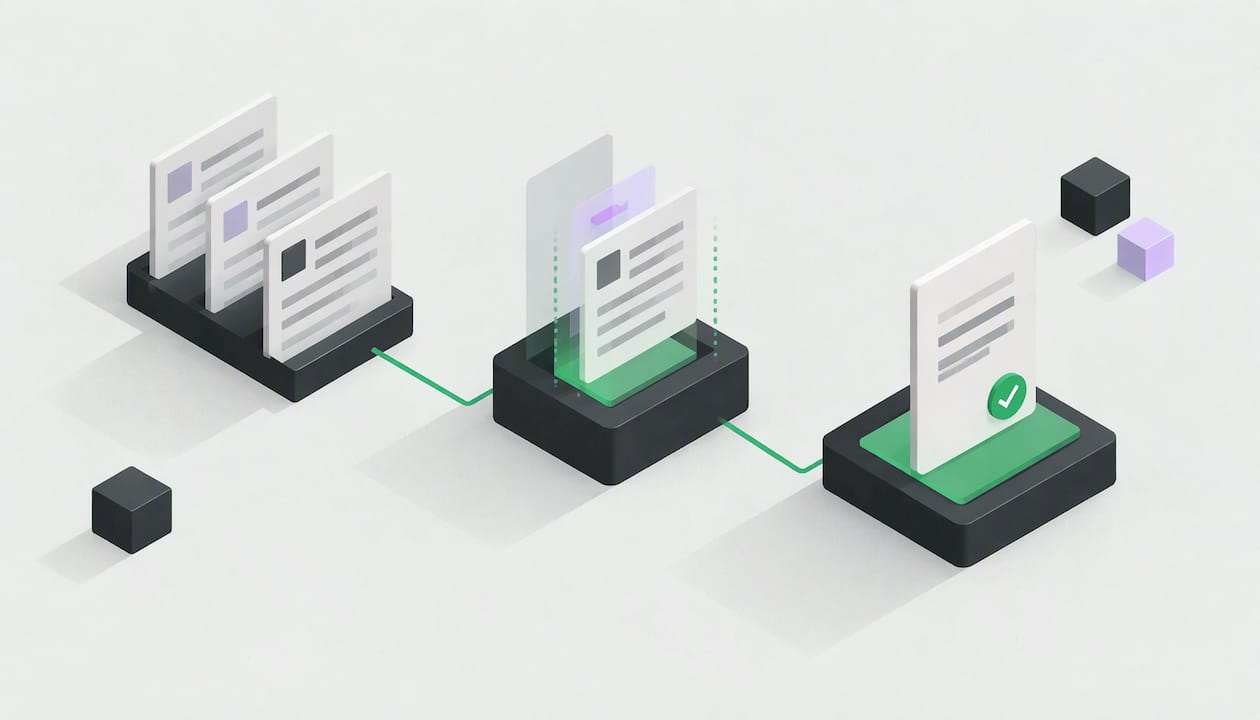
Quote automation with AI means software that takes an inbound request, gathers the missing facts, applies your pricing rules, produces the quote and follows up until the customer decides. It does this without a person rebuilding the quote by hand. For enterprises handling thousands of inbound leads a month, the value is not a faster document. It is removing the wait between a customer asking for a price and receiving one they can accept.
This guide covers what AI quote automation is, how the process runs step by step, how it relates to CPQ, CLM and quote-to-cash, which data and controls you need, and how to measure results.
TL;DR
- AI quote automation goes beyond filling a template: it collects inputs, checks eligibility, configures the offer, issues the quote and follows up.
- CPQ is the first step of quote-to-cash, and CLM governs the contract that follows. AI can work across all three, but each solves a different problem.
- Quote quality depends on clean product, pricing and contract data. Poor data produces mispriced quotes faster.
- Keep humans in the loop where the risk sits: exceptions, discounts above a threshold and anything legally binding that falls outside your rules.
- Start with one narrow use case, measure cycle time and error rate against a human baseline, then expand.
Table of Contents
- What AI quote automation is, and how it differs from quote generation
- How the process runs, from inbound request to follow-up
- CPQ, CLM and quote-to-cash: how they fit together
- What data and rules you need before you automate
- Risks and the human checks that keep quotes safe
- How to measure results and improve conversion
- Our perspective
- Where VoiceB fits
- FAQ
- Sources
What AI quote automation is, and how it differs from quote generation
Basic quote generation is a template with merge fields. A rep types in a product, a quantity and a customer name, and the system produces a PDF. It saves formatting time, but the rep still has to know the pricing, collect the details and chase the answer.
AI quote automation changes who does the work. The system handles the parts that used to wait on a specialist:
- Understanding the request. It reads or hears what the customer wants, whether that arrives by phone, email, chat or web form, and turns unstructured language into structured fields.
- Filling gaps. If a required input is missing, such as a service address, usage level or contract term, it asks for it in the conversation.
- Applying rules. It checks eligibility and selects the product, bundle and price your rules allow.
- Producing and sending the quote. It issues the quote in your format and delivers it right away.
- Following up. It answers questions, handles objections inside its rules and moves the customer toward acceptance.
The distinction that matters for enterprise buyers is between assistance and execution. An assistant drafts something for a person to finish. An autonomous agent completes the task and hands over to a person only when a rule says it should. Our guide to AI sales agents describes the different types and why the workflow, not the model, usually decides the return.
How the process runs, from inbound request to follow-up
The steps below describe a typical inbound flow. Your own rules decide where each one starts and stops.
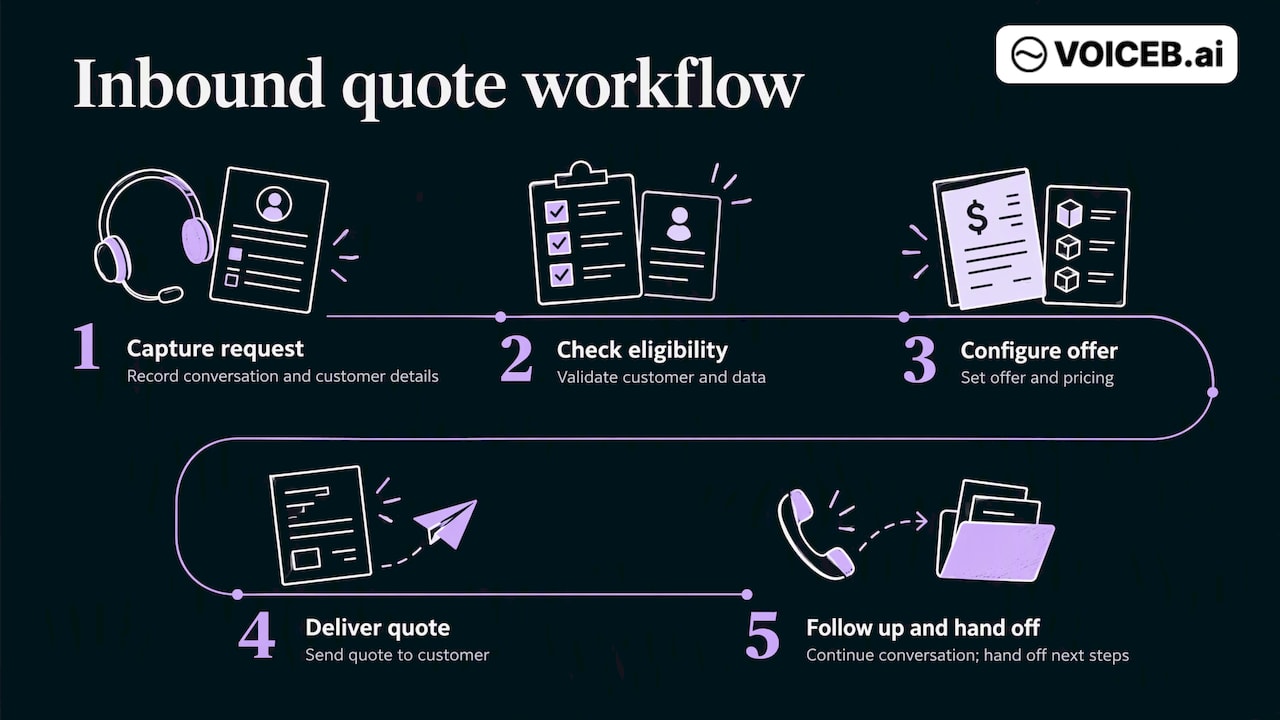
Step 1: The conversation
The customer calls, writes or submits a form. The agent greets them, identifies what they want and captures the details a quote needs. Speed matters here: the customer who asks for a price and waits hours for an answer often moves on to whoever replies first.
Step 2: Eligibility and data checks
Before any price is shown, the agent verifies that the customer can buy what they are asking for. Depending on your industry, that can mean checking coverage, credit, geography, existing contracts or product availability against your systems of record. This is where integration with your CRM and back-office systems stops being optional. An agent that cannot read your data can only guess.
Step 3: Offer configuration and pricing
With the facts confirmed, the agent configures the offer: the right plan, options, term and price according to your pricing rules. Discount limits, bundle logic and approval thresholds live here. The agent should never invent a price. It should select from what your rules permit and escalate anything outside them.
Step 4: Quote delivery
The quote reaches the customer immediately, in the channel they used or the one they prefer. A good quote states what is included, the price, the term and what happens next. If the customer agrees, the same flow can move on to contract generation instead of restarting in another tool.
Step 5: Follow-up and handoff
Most quotes do not close on first contact. Automated follow-up covers questions, reminders and revised options within your rules. When a customer needs a human, such as a complex negotiation or a request your rules do not cover, the agent hands over the full context so your team does not start from zero. Our outcome-based model is built around this idea: every conversation ends in a recorded result, whether a closed sale, a qualified transfer or a clean exit.
CPQ, CLM and quote-to-cash: how they fit together
These terms are often mixed up, and readers searching for AI quoting usually meet all three. Here is how they relate.
| Term | Scope | Main question it answers |
|---|---|---|
| CPQ (configure, price, quote) | Building a valid configuration, applying pricing, issuing the quote | What can we sell this customer, and at what price? |
| CLM (contract lifecycle management) | Drafting, negotiating, approving, storing and managing contracts | What exactly did we agree, and are we meeting it? |
| Quote-to-cash (Q2C) | The whole chain from quote through order, contract, billing and revenue collection | How does an interested prospect become collected revenue? |
CPQ vs quote-to-cash
CPQ is a part, and Q2C is the whole. According to Accenture’s quote-to-cash report, CPQ is the first step in Q2C, which starts when a customer, subscriber or prospect interacts with a brand and continues beyond the moment cash changes hands. That means a fast, accurate quote only pays off if the order, contract and billing steps behind it keep the same data intact.
CPQ vs CLM
CPQ decides what is offered and at what price. CLM governs the agreement that results and what happens to it over its life, including renewals and obligations. A quote can be perfectly priced and still create trouble if the contract language or terms drift from what was quoted. In practice, the two meet at the moment a quote becomes a contract, and that handoff is where many manual touchpoints remain.
Where AI fits
AI for CPQ typically means understanding requests in natural language, selecting configurations and suggesting or applying prices within rules. AI for CLM typically means reading and drafting contract text and checking it for risk. Autonomous inbound sales sits in front of both: it handles the conversation, runs the checks, configures the offer and generates the contract inside your existing systems, so a lead moves from first question to signed agreement without being re-keyed along the way.
What data and rules you need before you automate
Automation amplifies whatever you feed it. If your product catalog, price books and eligibility rules are inconsistent, the agent will produce inconsistent quotes at higher volume.
MGI Research’s 2025 report states that AI-enabled quote-to-cash needs clean, dynamic, near-real-time product, pricing, contract and usage data. It also notes that poor data can lead to mispriced, unfulfillable quotes and amplify errors. Accenture’s report makes a related point: modern quote-to-cash calls for a single source of truth that is interoperable across systems, so data silos do not make the process rigid.
A practical readiness checklist:
- Product and pricing data. One current price book, with plans, options, bundles, terms and regional differences written down.
- Eligibility rules. The exact conditions under which a customer can or cannot buy, expressed as rules a system can test rather than knowledge held by one person.
- Discount and approval policy. Who can approve what, and the limits within which the agent may act alone.
- System access. Read and write access to your CRM and the systems that hold customer, product and contract data.
- Contract templates. Approved templates and clause variants, so generated contracts match what was quoted.
- Escalation paths. Named queues or people for exceptions, with a clear handoff of context.
Integration effort varies by stack. On our pricing page, custom integrations are billed at €900 per day per DevDay, which gives you a way to scope that work against the systems you need to connect.
Risks and the human checks that keep quotes safe
Quotes are commitments. A wrong number is not a typo, it is an offer a customer may accept.
The main risks are worth naming plainly:
- False output. Generative AI can produce false assertions, as Washington Technology noted in 2024 in its analysis of generative AI for proposal development.
- Bad data. The MGI Research report warns that inaccurate or unclean data can cause mispriced, unfulfillable quotes, billing errors, compliance exposure and reputational harm.
- Unstructured information. In an Accenture survey, nearly 8 in 10 C-suite executives said that 50% to 90% of their data is unstructured and inaccessible, which makes a stable quote-to-cash core harder to build.
The same sources point to the same remedies: validation, governance, audit trails and human review for customer-facing and financial artifacts. In practice, that means:
- Constrain the agent to your rules. It selects from approved offers and prices, and does not generate commercial terms freely.
- Set autonomy by risk. Let the agent act alone on standard, low-risk quotes and require approval for large deals, unusual terms or discounts above a threshold.
- Keep an audit trail. Every quote should be traceable to the inputs, rules and conversation that produced it.
- Review samples regularly. Have your pricing or deal desk team check a sample of automated quotes each week at the start, then adjust rules where errors appear.
This is why we structure autonomy in levels, so you decide how much the agent does on its own at each stage. You can see how that works on our platform page.
How to measure results and improve conversion
MGI Research recommends piloting narrow use cases, measuring KPIs such as cycle time and error rate, benchmarking AI against human baselines and expanding only when value and control objectives are met. That is a sound approach for quoting. A workable plan looks like this:
- Pick one flow. Choose a single product line or segment with clear rules and steady inbound volume.
- Record the human baseline. Measure how long a quote takes today from first contact, how often quotes contain errors, and what share of quotes convert.
- Run the agent in parallel or on a slice of traffic. Compare like for like.
- Track a short list of metrics. Time from request to quote, quote error rate, quote-to-close rate, escalation rate and cost per closed sale.
- Expand when controls hold. Add products, regions or channels only after accuracy and control targets are met.
Conversion improves mainly through speed and consistency. Every lead gets an answer at once, every quote follows the same rules, and no lead waits in a queue. Your own numbers from the pilot are the only ones that matter for your business case. For a structured look at cost and speed against a human team, see our comparison of AI agents and human inbound sales teams.
Our perspective
Most quote automation stops too early. It produces a document and leaves the hard parts to people: checking whether the customer is eligible, choosing the right configuration, answering the follow-up question and turning an accepted quote into a contract. Each of those handoffs is a place where leads go cold and costs rise.
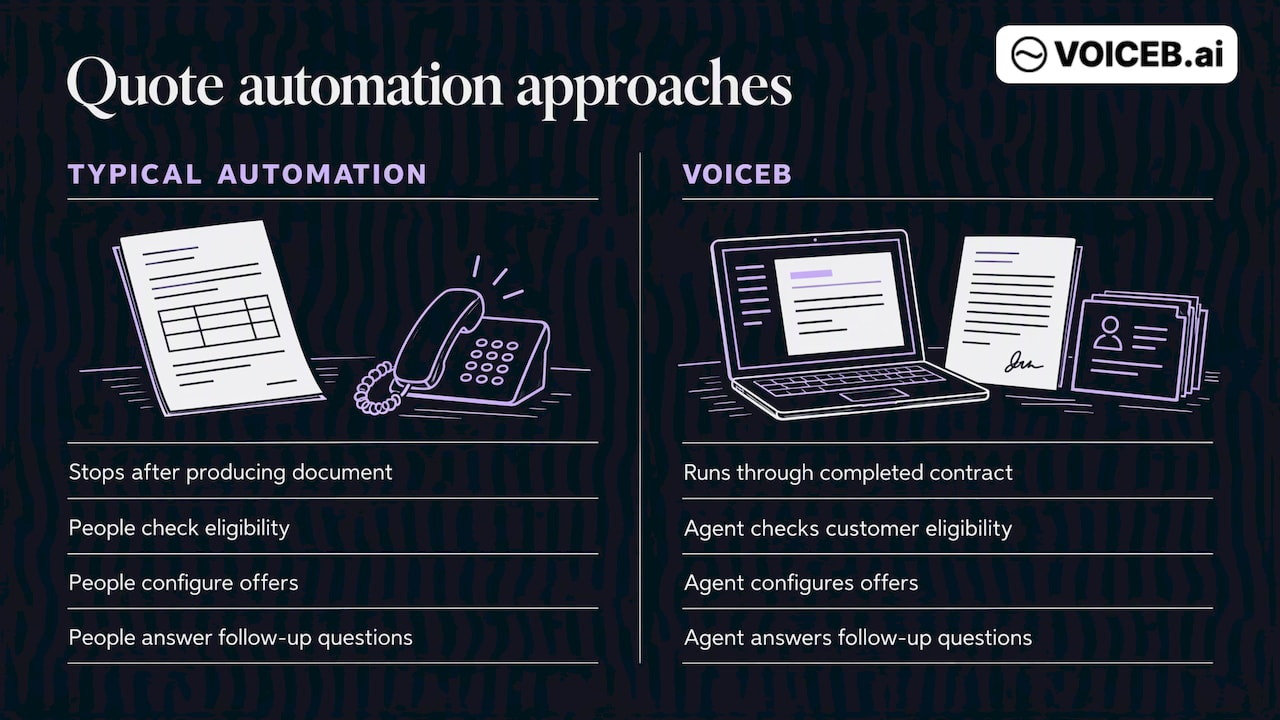
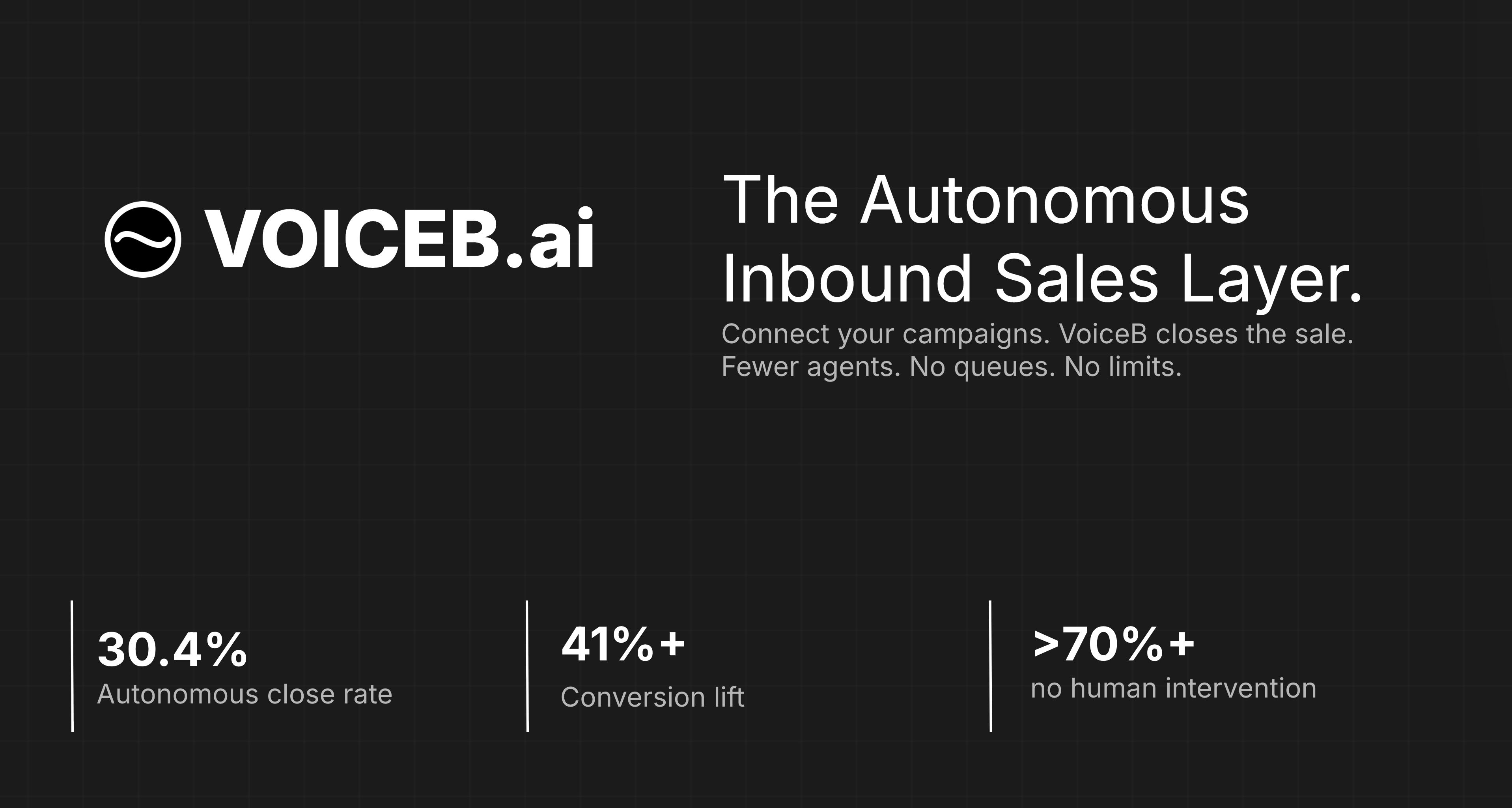
We built VoiceB around the opposite idea. The agent executes the sales workflow from the first conversation to the completed contract, operating across your existing systems rather than beside them. Eligibility checks, offer configuration and contract generation are part of the job, not extras. Primagas (SHV Energy) saw a 150% increase in sales volume, 250% more lead-handling capacity and a 37% reduction in cost per acquisition, with a 67.8% autonomous close rate over 12 months. Holaluz closes 30.4% of valid inbound calls autonomously and auto-filters 78% of traffic.
We also believe autonomy has to be earned. Start narrow, keep the rules explicit, keep humans on the exceptions and let the data show when to widen the scope. Speed without control only moves mistakes faster.
— Alex Bisbe, Co-founder & CEO, VoiceB.ai
Where VoiceB fits
Every VoiceB deployment runs on Autonomous Sales Voice Agents (ASVA), and every conversation is classified by the Outcome Engine: a deterministic, auditable classification that assigns one of four outcomes, Invalid, Qualified Transfer, Sold or Closed. See how this works in production in our case studies for Primagas (SHV Energy) and Holaluz.
Autonomous agents own the routine inbound sale end to end, from first response through eligibility, offer configuration and contract generation; humans handle genuine exceptions outside approved rules.
If your team handles thousands of inbound leads a month and quoting is a bottleneck, our Autonomous Sales agents take a request through qualification, eligibility, offer configuration and contract generation inside your existing systems. Pricing is tied to outcomes: the published fees start from €1.50 for a qualified transfer, from €7 for a sold lead and from €15 for a closed one, with plan details on the pricing page.
If you want to begin with qualification before full autonomy, our AI lead qualification service covers that first step, and you can move up the autonomy levels as your rules and results mature.
FAQ
What is the difference between AI quote automation and CPQ software?
CPQ software applies configuration and pricing rules to produce a valid quote, usually with a person driving it. AI quote automation adds the layers around that: understanding the request in natural language, collecting missing inputs, checking eligibility and following up. The two can work together, with CPQ-style rules acting as the guardrails the AI operates within.
Can AI generate quotes without human review?
It can for standard, low-risk quotes that fall entirely within approved rules. For large deals, unusual terms or discounts above a set limit, human review is the safer design. The research on quote-to-cash recommends validation, governance, audit trails and human review for customer-facing and financial documents.
What data does sales quote automation need?
At minimum, a current price book, product and bundle definitions, eligibility rules, discount policies and access to customer records in your CRM. Contract templates matter as well if the quote should flow into a contract. Clean, consistent data matters more than volume.
How do I know if quote automation is working?
Compare it with your human baseline on a narrow use case. Track time from request to quote, error rate, quote-to-close rate, escalation rate and cost per closed sale. Expand only when accuracy and control targets are met.
Is AI quote automation only for large enterprises?
The approach pays off most where inbound volume is high and the quoting rules are consistent, which is why we focus on enterprises handling thousands of inbound leads a month, in sectors such as telecom, energy and large-scale B2C services. Lower volumes rarely justify the integration and governance effort.
Sources
- The rewards and risks of investing in GenAI for proposal development, Washington Technology
- Unlocking agility with a modern approach to Quote to Cash, Accenture
- How Will Gen AI Impact Quote-to-Cash (Q2C)?, MGI Research