

Build vs. Buy AI: A Decision Guide for Enterprise Sales Teams
For most enterprises, buying is the right call for inbound sales automation, and building makes sense only for the thin layer of logic that is truly proprietary. The reason is not that engineers can’t build an AI agent. They can. The reason is that the model is the smallest part of the job: integrations, governance, monitoring and workflow redesign decide whether the system ever produces revenue. This guide gives you the cost data, a scoring method and a hybrid pattern so you can decide with evidence.
TL;DR
- Buy when the use case is common, speed matters and the vendor already runs it in production. Build when the workflow is itself your competitive edge.
- Total cost of ownership is where build decisions go wrong: Gartner estimates $8M to $20M up front for models built from scratch, against $100k to $200k for an enterprise license.
- You keep accountability for AI outcomes whichever route you choose, so governance and contract terms belong in the decision from day one.
- The strongest pattern is hybrid: buy the platform for heavy lifting, build a small logic layer for your own sales rules.
Table of Contents
- What “build vs. buy” means for AI
- The real cost of building
- The case for buying
- When building is the right answer
- A scoring framework you can run in an afternoon
- Accountability does not transfer to the vendor
- Why the bolt-on approach fails, whether you build or buy
- The hybrid path: buy the platform, build the logic layer
- Our perspective
- How VoiceB fits the buy and hybrid routes
- A practical sequence for deciding
- FAQ
- Sources
What “build vs. buy” means for AI
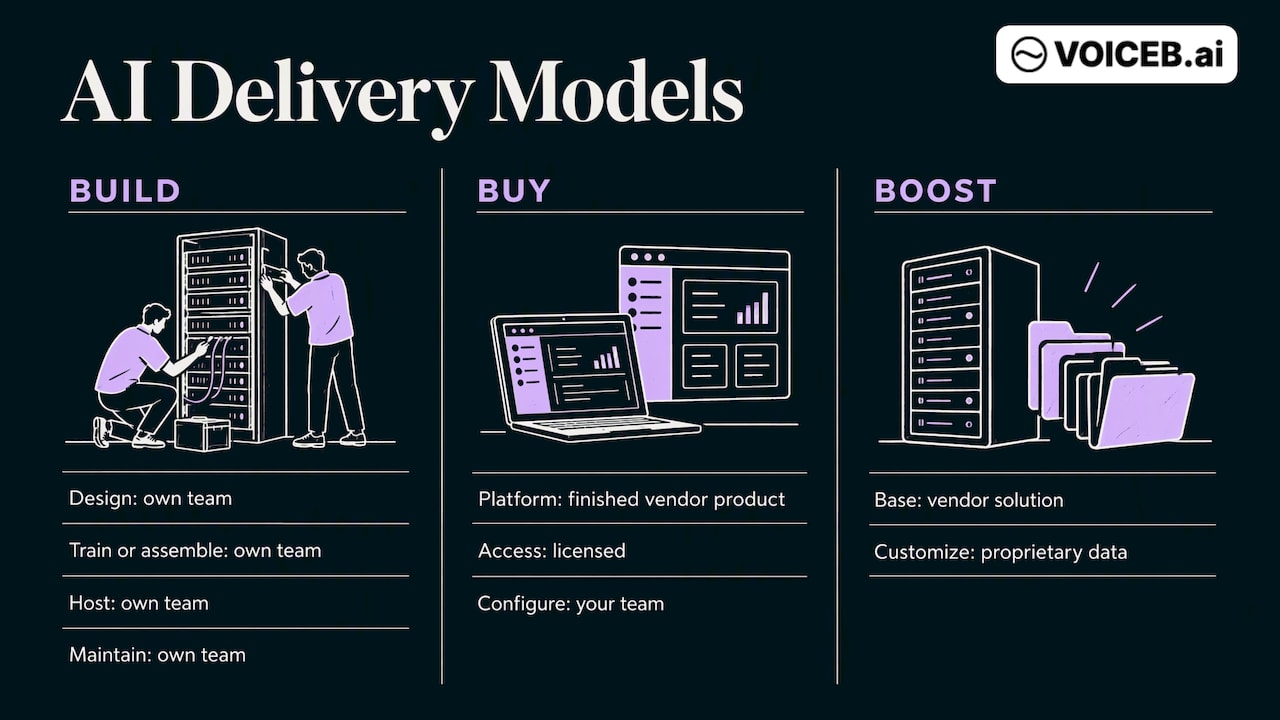
Build means your own team designs, trains or assembles, hosts and maintains the AI system. Buy means you license a finished platform from a vendor and configure it. MIT Sloan describes a third option, boost: take a vendor solution and customize it with your proprietary data. In practice, most enterprise decisions land somewhere between the poles.
The question looks different for sales automation than for, say, an internal research tool. An inbound sales workflow touches your CRM, pricing and eligibility rules, contract templates, telephony, compliance requirements and customers who are ready to buy. Failure is visible in lost deals, not just in a disappointing demo.
The real cost of building
The visible cost of a build is development. The invisible cost is everything after launch: cloud storage for large data volumes, talent acquisition and compensation, and continuous maintenance. The Communications of the ACM summary of Gartner figures puts the gap in numbers:
| Route | Up-front cost | Ongoing annual cost per user |
|---|---|---|
| Custom model built from scratch | $8M to $20M | $11k to $21k |
| Mid-range custom application | $750k to $1M | $1,300 to $11,000 |
| Enterprise license (bought) | $100k to $200k | $280 to $550 |
Treat these as ranges for planning, not quotes. Your numbers depend on scope, but the pattern is consistent: building front-loads cost and keeps per-user costs high, while buying keeps both lower.
For an inbound sales agent you rarely need a model built from scratch. The realistic build is an application on top of a foundation model. That is the mid-range row, and it still means a team that owns prompts, retrieval, voice and telephony, evaluation, security reviews and incident response indefinitely.
Costs that rarely make the business case
- Integration work. Eligibility checks, offer configuration and contract generation each need reliable read and write access to your systems of record.
- Evaluation and monitoring. Someone must test conversations, catch drift when a model version changes and keep an audit trail.
- Redundancy. If a vendor already solves the commodity part, building it again is a recurring tax on your engineering roadmap.
- Opportunity cost. Every quarter spent on a pilot is a quarter of inbound leads handled the old way.
The case for buying
Buying gives you speed and a proven operating model. A platform that already runs inbound conversations at volume has met the edge cases you haven’t: interrupted callers, ambiguous eligibility, handoffs to a human, a CRM that returns an error mid-call.
There is also a results argument. According to McKinsey’s State of AI 2025 as summarized by Libertify, 88% of organizations use AI in at least one business function, yet only 5.5% report enterprise-level EBIT impact above 5%. Another analysis of the same survey notes that this comes from 109 of 1,933 respondents. Access to AI is not the bottleneck. Conversion of pilots into production is.
That finding should change how you read the build vs. buy question. If value comes from rewiring workflows rather than from owning the model, the sensible move is to shorten the path to a production workflow and spend your scarce internal effort on process design.
When building is the right answer
Building earns its cost in a narrow set of conditions:
- The workflow is your differentiator. Your pricing logic, underwriting rules or customer journey is something competitors cannot copy, and a generic platform would flatten it.
- You have regulatory or data-residency constraints that no available vendor can meet.
- You already have the team. ML engineers, conversation designers, platform and security staff exist and have capacity beyond the first release.
- The scale justifies it. Volume is high enough that the long-run unit economics beat a license, after counting maintenance honestly.
If you cannot tick at least three of these four, a full build is probably a prestige project. If you can, you still don’t need to build everything, as the hybrid model below shows.
A scoring framework you can run in an afternoon
Gather sales, operations, IT, legal and finance in one room and score each criterion from 1 (favors buy) to 5 (favors build). Weight the criteria by importance to your business, then compare totals.
| Criterion | Question to answer | Favors buy when | Favors build when |
|---|---|---|---|
| Time to value | How soon must inbound leads convert? | You need results this year | You can wait 12 to 24 months |
| Differentiation | Does this workflow set you apart? | It is standard across the industry | It encodes unique sales rules |
| Total cost | What is the five-year TCO? | License plus integration is lower | Internal run costs undercut it at scale |
| Talent | Do you have people who can own it? | Team is stretched | Team is in place and funded |
| Integration | How complex are your systems? | Vendor has connectors for your stack | Heavily bespoke legacy systems |
| Governance | Who can audit and control behavior? | Vendor provides logs and controls | You need full code-level control |
| Lock-in | How hard is it to switch later? | Data and logic are portable | Dependency would be strategic risk |
A tip on running the session: ask each function to score independently before discussing. IT tends to overweight control, sales tends to overweight speed, and the gap between the two is the real conversation.
Accountability does not transfer to the vendor
Many teams assume buying shifts the risk. It shifts the engineering, not the accountability. According to guidance on third-party AI vendor management, when you deploy a third-party AI system you own the accountability, and compliance obligations sit with you under frameworks such as the EU AI Act and the NIST AI RMF. If you operate in the EU, check which obligations apply to your use case with legal counsel; if you operate only in the US, the NIST framework is voluntary guidance but is widely used as a benchmark.
MIT CISR’s mapping of generative AI risk points the same way and recommends fallbacks that you design before production, such as reverting to a manual process when the system misbehaves. For an inbound sales workflow, that means a defined path to a human agent and a kill switch you can use without calling the vendor.
What to put in the contract
Standard software terms were not written for AI. Before you sign, ask the vendor for written answers on:
- Change notification: how and when you are told about model or behavior updates. MIT Sloan’s research argues that vendor transparency about updates and roadmap matters because AI models change quickly.
- IP indemnification for training data and outputs.
- Data handling: where call recordings and customer data are stored, who can access them, and retention periods.
- Audit evidence: conversation logs, decision traces and reporting you can hand to a regulator or internal audit.
- Exit terms: how you export data and configurations if you leave.
Silence on any of these topics is itself a signal. A vendor that has run enterprise deployments should answer without hesitation.
Why the bolt-on approach fails, whether you build or buy
The decision is not only about who writes the code. Practitioners writing on the enterprise AI scaling gap argue that organizations that simply add AI to legacy workflows achieve only marginal gains, and that real value comes from redesigning the operating model around what the AI can do autonomously. The McKinsey data cited above points in the same direction: organizations that scale AI are 2.8x more likely to have redesigned workflows.
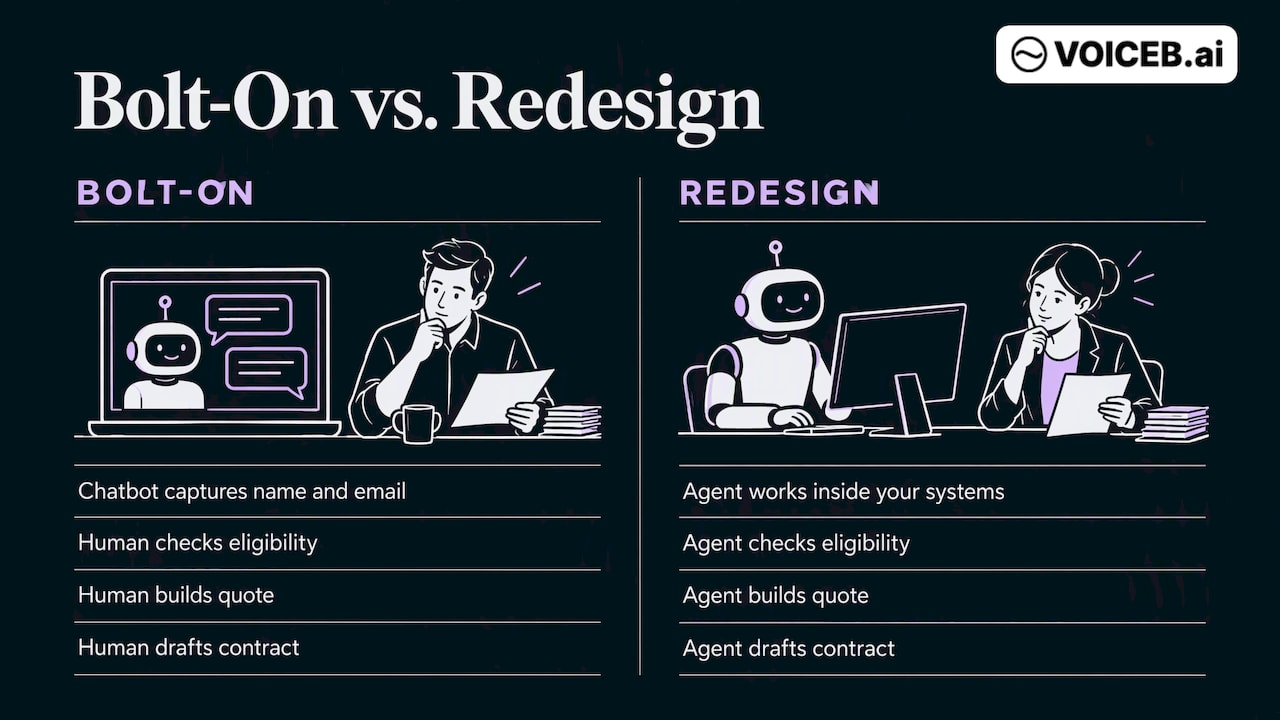
In sales, bolting on looks like this: a chatbot collects a name and email, creates a lead, and a human still checks eligibility, builds the quote and drafts the contract. Response time improves, but the cost of the human steps stays. Redesign means the agent performs those steps itself, inside your systems, and humans handle exceptions and high-value negotiations.
The hybrid path: buy the platform, build the logic layer
The most durable pattern we see recommended is an orchestration approach. A Stanford Law playbook on enterprise-ready generative AI is a useful starting point on production readiness. The pattern itself is simple:
- Buy the specialized platform that handles conversations, voice, integrations and monitoring.
- Build a small logic layer that encodes your proprietary sales rules: which customers qualify for which offers, how discounts are approved, what a valid contract contains.
- Keep ownership of data, prompts and rules in a form you can move.
This gives you vendor-managed stability for the heavy lifting and your own code where differentiation lives. It also keeps your engineering team on work that competitors cannot buy.
Our perspective
We build AI agents that run inbound sales end to end, so we see the build vs. buy question from the buyer’s side every week. Our view is direct: the teams that struggle are rarely the ones that chose wrong between build and buy. They are the ones that measured the wrong thing.
A qualification-only agent is easy to build and easy to buy. It also leaves the expensive part of the funnel untouched. Value shows up when the agent checks eligibility, configures the offer and generates the contract inside your existing systems, so that a lead becomes a signed customer without a manual touchpoint. That is the standard we hold ourselves to, and it is the standard we suggest you hold any vendor or internal team to.
So evaluate on outcomes. Ask what share of conversations end in a completed contract, how exceptions reach a human, and what the audit trail looks like. Primagas (SHV Energy) saw a 150% increase in sales volume, 250% more lead-handling capacity and a 37% reduction in cost per acquisition, with a 67.8% autonomous close rate over 12 months. Holaluz closes 30.4% of valid inbound calls autonomously and auto-filters 78% of traffic. Those numbers came from the agent executing sales tasks, not just routing leads.
Our practical advice: if your inbound volume is in the thousands of leads per month, don’t start with a two-year build. Run a bounded production deployment, measure it against your human baseline, and keep your engineers focused on the rules that are uniquely yours.
— Alex Bisbe, Co-founder & CEO, VoiceB.ai
How VoiceB fits the buy and hybrid routes
If you land on buying or the hybrid model, Autonomous Sales is the offer built for it: Autonomous Sales Voice Agents (ASVA) that handle the inbound workflow from first conversation to completed contract across your existing systems. If you want to start with qualification, see AI Lead Qualification. Teams that want to shape agent behavior themselves can look at Agent Studio, which is built to create and govern autonomous sales agents.
Every VoiceB deployment runs on Autonomous Sales Voice Agents (ASVA), and every conversation is classified by the Outcome Engine: a deterministic, auditable classification that assigns one of four outcomes, Invalid, Qualified Transfer, Sold or Closed. See how this works in production in our case studies for Primagas (SHV Energy) and Holaluz.
The commercial model is outcome-linked, which keeps the cost comparison with a build straightforward. Published fees on our pricing page include Qualified Transfer from 1.50 EUR one-off, Sold from 7 EUR one-off and Closed from 15 EUR one-off. Custom Integrations are 900 EUR per day per DevDay. Plans (Starter, Enterprise and Corporate Custom) have no published price, so contact us for a quote. For a side-by-side with staffing costs, read our comparison of AI voice agents vs. human sales teams.
A practical sequence for deciding
- Define the outcome in revenue terms. For example: contracts signed per 1,000 inbound leads, and cost per acquisition.
- Map the workflow end to end. List every step between first contact and signed contract, and mark which require a human.
- Score the criteria with the table above, using five-year TCO rather than first-year cost.
- Run the vendor due diligence. Request the contract answers listed earlier, and review how the vendor handles the types of sales agents and autonomy levels on its platform.
- Pilot in production, not a sandbox, with a human fallback and a defined success metric.
- Decide what to build only after the pilot shows which of your rules the platform cannot express.
The point of the sequence is to turn an opinion contest into a measurement. A pilot with real inbound traffic answers more than another round of slides.
FAQ
Is it cheaper to build or buy AI?
Buying is usually cheaper in the first years. Gartner figures reported by CACM show enterprise licenses at $100k to $200k up front, versus $750k to $1M for a mid-range custom application. Building can pay off at very high scale, but only if you count maintenance and talent honestly.
How much does it cost to build AI?
It depends on scope. The same Gartner-based estimates range from $750k to $1M for a mid-range custom app to $8M to $20M for a model built from scratch. Ongoing annual costs per user are also higher for custom builds.
Can I buy AI and still keep control?
Yes. The hybrid approach lets you license the platform and build your own logic layer for proprietary rules. Negotiate data-handling, change-notification and exit terms so you can audit and move your configuration.
Who is responsible if a vendor’s AI makes a mistake?
You remain accountable for outcomes. Third-party AI risk guidance notes that compliance obligations do not transfer to the vendor. Confirm your specific obligations with legal counsel and set up monitoring and a manual fallback.
Sources
- GenAI: The Buy vs. Build Solution, Communications of the ACM
- Buy, boost, or build? Choose your path to generative AI, MIT Sloan
- State of AI 2025: McKinsey Report, Libertify
- McKinsey State of AI 2025: What It Means for Engineering Leaders
- Third-Party AI and Vendor Management: Risks You Don’t Control
- Mapping the Generative AI Risk Space, MIT CISR
- The enterprise AI scaling gap
- Building for Production: A Revised Playbook for Enterprise-Ready Generative AI Solutions, Stanford Law