

Sales Ops Automation: What to Automate and How to Do It

Sales ops automation means moving the repetitive, rule-based work of your sales operation out of manual hands and into systems that run it the same way every time: lead routing, CRM updates, eligibility checks, offer configuration, follow-up and contract generation. For enterprises with high inbound volume, the biggest gains come from automating the full path from first conversation to signed contract, not just the admin around it. This guide shows what to automate first, how to build workflows that do not break, and where autonomous AI agents fit.
TL;DR
- Start with the work that is high in volume and low in judgment: routing, data entry, eligibility checks, follow-up cadences and contract generation.
- Automation needs an explicit contract: a trigger, defined inputs and outputs, an owner and a terminal failure state. Without it, errors hide behind success signals.
- Build idempotent workflows, so a rerun never creates duplicate CRM records or repeated outbound messages.
- Most automation stops at qualification. Autonomous agents go further and execute the sale across your existing systems.
- Measure outcomes (qualified transfers, sold, closed), not activity.
Table of Contents
- What sales ops automation covers
- Why it pays: what the research shows
- What to automate first
- Build workflows that do not fail quietly
- Own your stack configuration
- Where conventional automation stops
- From automation to autonomous execution
- Our perspective: automate the outcome, not the task list
- How to roll it out in six steps
- Metrics that show whether automation works
- What it costs with VoiceB
- Common mistakes to avoid
- FAQ
- Sources
What sales ops automation covers
Sales operations has moved from a tactical, cost-control role to a strategic one. Best-in-class companies increasingly run marketing, sales and service operations as one data-driven group, a “control tower” that owns both the technology and the go-to-market execution. Automation is how that group scales without adding headcount for every new lead source.
In practice, the scope breaks into five layers:
- Lead capture and routing. Inbound leads from web forms, calls, chat and partners are deduplicated and assigned by territory, product or capacity.
- CRM hygiene. Fields are populated, stages are updated, activities are logged and duplicates are merged without a rep typing anything.
- Qualification and eligibility. Each lead is checked against your rules: coverage area, credit criteria, product fit, contract constraints.
- Offer and contract. The right offer is configured and the contract is generated and sent for signature.
- Follow-up and reactivation. Leads that stall get timed, personalized outreach, and dormant records are revisited.
Most tools on the market cover layers one and two well. Fewer reach layers three to five, and that is where inbound revenue is won or lost.
Why it pays: what the research shows
The numbers below come from published studies, mostly on CRM-centered automation. They are not VoiceB results, and your outcome will depend on your starting point.
- A study of cloud-based AI sales optimization found average annual revenue growth of 18.6% versus 7.9% for non-optimized organizations, with lead conversion rising from 21.4% to 33.8%.
- A 2025 analysis of automated sales performance tracking reports that robust CRM automation delivers a 75% reduction in time spent on manual data entry and a 29% shorter sales cycle.
- Field experiments on generative AI in online retail suggest its value comes mainly from reducing friction in search, information and communication, and that satisfaction metrics stay stable while sales output rises.
The common thread is friction. Every handoff, wait and manual re-entry between a buyer’s first message and a signed contract is a place where intent decays.
What to automate first
Use a simple filter. A task is a strong candidate when it is frequent, rule-based, and expensive when delayed. Rank your candidates on those three criteria and begin at the top.
| Task | Volume | Rule-based? | Cost of delay | Priority |
|---|---|---|---|---|
| Lead routing and assignment | High | Yes | High | Start here |
| CRM data entry and logging | High | Yes | Medium | Start here |
| Eligibility checks | High | Yes | High | Start here |
| Offer configuration | Medium to high | Mostly | High | Second wave |
| Contract generation | Medium to high | Yes | High | Second wave |
| Reactivation of dormant leads | Batch | Partly | Medium | Second wave |
| Complex, multi-stakeholder deals | Low | No | Varies | Keep human-led |
The last row matters. Automation is not a replacement for a senior rep on a six-figure negotiation. It frees reps from the high-volume inbound work so that their time goes to deals that need judgment.
Build workflows that do not fail quietly
The usual failure mode is not a workflow that crashes. It is one that appears to succeed while records are wrong. A guide on RevOps workflow automation argues that each workflow needs an explicit contract: a trigger, input and output schemas, an owner and a terminal failure state. Without that, you accumulate process debt, with failures hidden behind generic success signals instead of surfacing in an exception queue.
Four practices follow from this.
Define the contract before the steps
Write down what starts the workflow, what data it needs, what it produces and who is responsible when it fails. If you cannot name the owner, the workflow is not ready for production.
Make every run idempotent
The same guide describes an idempotency rule for high-volume inbound: a rerun after a transient error must never produce duplicate CRM records, redundant messages or double billing. The practical method is to give every step a stable ID and a terminal failure state, so a retry updates the existing record rather than creating a new one.
Send failures to a queue a person reads
A lead that cannot be qualified, a contract that fails validation, an address that does not match any coverage rule: each should land in a named exception queue with a reason code. Review that queue daily. It is also your best source of process improvements.
Treat automation like code
The same source recommends that successful teams keep automation version-controlled, tested and reviewed, rather than treating it as a set of drag-and-drop tasks. For a sales ops team, that means a staging environment, a change log and an approval step before a routing rule goes live.
Own your stack configuration
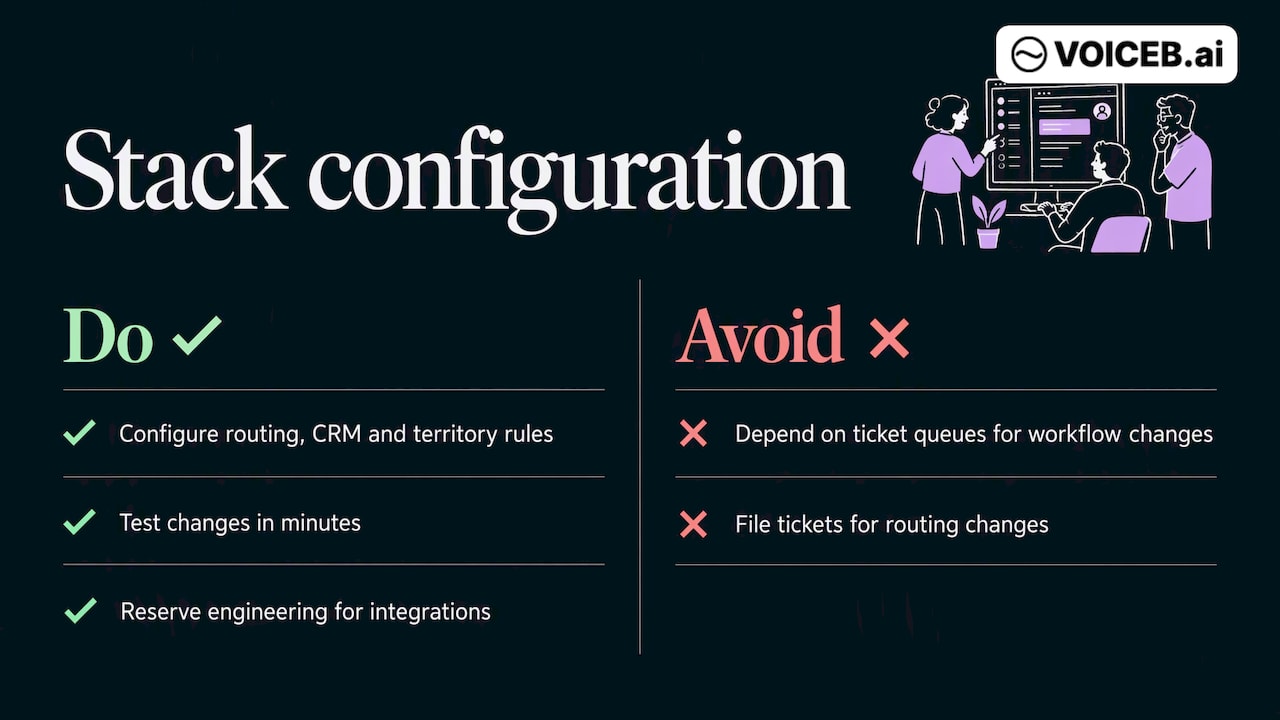
Maturity in sales ops correlates with independence. According to a sales operations maturity framework, teams that depend on ticket queues for workflow changes are effectively stalled, while mature teams configure lead routing, CRM hygiene and territory rules directly, and can test a change in minutes rather than waiting on developer bandwidth.
Ask yourself one question: can your ops team change a routing rule today without filing an engineering ticket? If not, you are operating reactively, and any automation you add will inherit that bottleneck. Choose tools that let ops configure and govern behavior, and reserve engineering time for real integrations.
Where conventional automation stops
Rules-based automation and most AI lead tools share a limit: they hand the lead off. A score is attached, a meeting is booked, a rep is notified. Everything after that, including checking eligibility, configuring the offer, answering objections and producing the contract, still waits for a person.
For enterprises handling thousands of inbound leads a month, that handoff is expensive in two ways. Response time grows as queues grow, and the rep’s day fills with routine cases that always resolve the same way. Sales ops ends up automating the edges while the core of the sale stays manual.
From automation to autonomous execution
An autonomous sales agent closes that gap. Instead of qualifying and passing along, it runs the inbound sales workflow itself, from the initial conversation to a completed contract, inside the systems you already use.
Here is what that workflow looks like in an enterprise setup:
- A lead arrives through a call, form or campaign response, and the agent opens the conversation immediately.
- The agent checks eligibility against your rules and data, so unqualified leads are filtered without consuming rep time.
- It configures the offer that fits the customer’s situation and your product constraints.
- It generates the contract and moves the customer to signature.
- Your CRM is updated at each step, with a clean record of what was said and decided.
- Exceptions go to people, with full context, when a case needs judgment.
This is the approach VoiceB takes. Its Autonomous Sales Voice Agents (ASVA) execute the inbound sales process rather than only qualifying leads, and they operate across your existing systems. Primagas (SHV Energy) saw a 150% increase in sales volume, 250% more lead-handling capacity and a 37% reduction in cost per acquisition, with a 67.8% autonomous close rate over 12 months. Holaluz closes 30.4% of valid inbound calls autonomously and auto-filters 78% of traffic. You can see how this plays out by sector on the pages for energy, utilities, banking, insurance and automotive.
Every VoiceB deployment runs on Autonomous Sales Voice Agents (ASVA), and every conversation is classified by the Outcome Engine: a deterministic, auditable classification that assigns one of four outcomes, Invalid, Qualified Transfer, Sold or Closed. See how this works in production in our case studies for Primagas (SHV Energy) and Holaluz.
Our perspective: automate the outcome, not the task list
We see the same pattern in enterprise sales operations again and again. Teams automate task by task: a routing rule here, an enrichment step there, a reminder somewhere else. Each one helps, and each one adds another system to maintain. Yet the buyer’s experience barely changes, because the sale still pauses every time a person has to pick it up.
Our view is that the unit of automation should be the outcome. A lead that becomes a qualified transfer, a sale or a closed contract is the thing the business pays for. So we build agents that own the path to that outcome, and we price the platform so that it reflects those outcomes (more on that below).
Three convictions shape how we work:
- Execution beats scoring. A qualified lead that waits is a cooling lead. The agent should keep going until the sale is done or a person is genuinely needed.
- Existing systems stay in place. Sales ops teams have spent years tuning their CRM and tooling. Autonomous execution should work across that stack, not demand a replacement.
- Governance is part of the product. Ops should be able to configure, test and control how agents behave, in line with the independence that mature teams expect. That is the purpose of our Agent Studio.
Autonomous agents own the routine inbound sale end to end; people step in only on genuine exceptions.
— Alex Bisbe, Co-founder & CEO, VoiceB.ai
How to roll it out in six steps
- Baseline your funnel. Record response time, qualification rate, time to contract, cost per acquired customer and the share of leads that never get a follow-up.
- Map the inbound path. Document every step from first touch to signed contract, and mark each as rule-based or judgment-based.
- Write the contract for each workflow. Trigger, inputs, outputs, owner, failure state.
- Pilot on one segment. Choose a product or region with high volume and clear rules. Keep exception handling visible.
- Review the exception queue weekly. Convert recurring exceptions into new rules or better data.
- Expand and reactivate. Once the live path is stable, extend to more segments and run reactivation on dormant CRM records. Our Reactivation Module is built for the latter.
If you are comparing the economics of agents and staffed teams, our page on AI voice agents versus human sales teams covers cost, speed and ROI in detail.
Metrics that show whether automation works
Activity metrics, such as emails sent or tasks completed, say little about revenue. Track these instead:
- Speed to first response. Time from lead creation to first real conversation.
- Qualified transfer rate. Share of leads that pass your eligibility rules and reach the next stage.
- Sold and closed rate. Share of leads that become a sale and a completed contract.
- Time to contract. Total elapsed time from first touch to signature.
- Cost per acquired customer. The fully loaded figure, including rep time.
- Exception rate. Share of runs that end in the failure queue, and how fast they are cleared.
- Data quality. Duplicate rate and field completeness in the CRM.
Watch exception rate and data quality alongside the revenue metrics. A rising exception rate is an early warning that a rule, an integration or a data source has changed.
What it costs with VoiceB
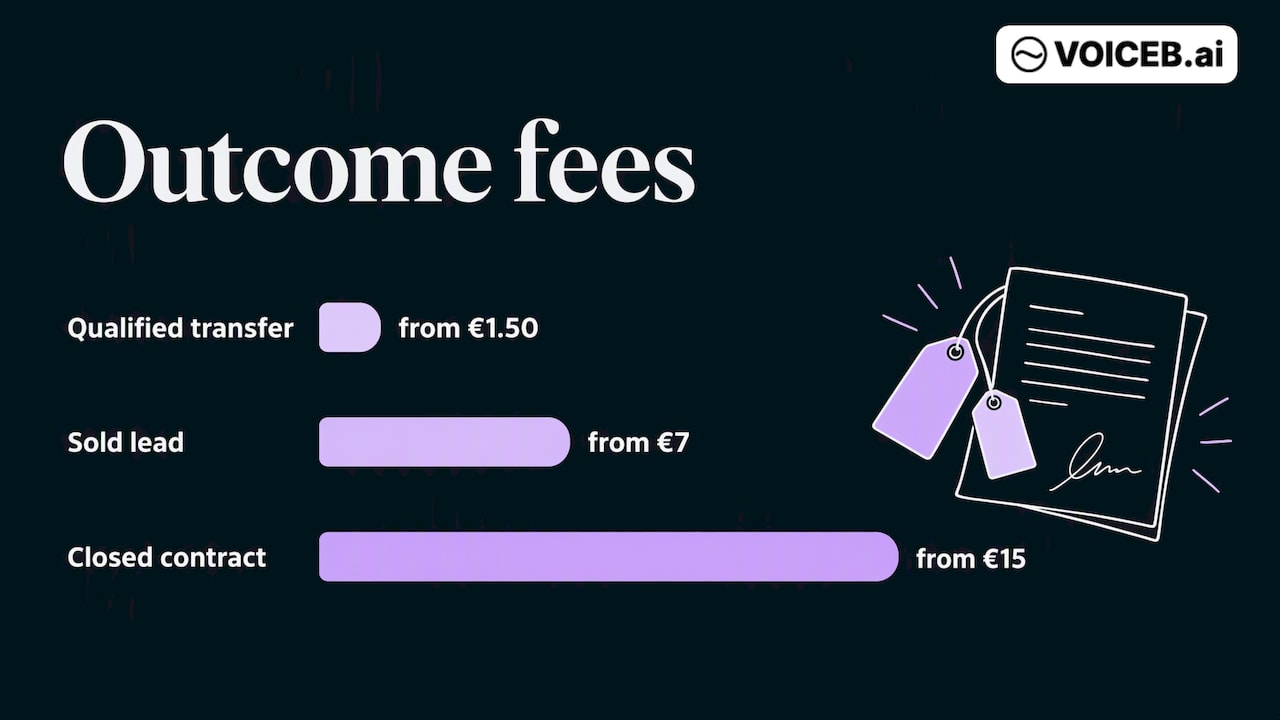
VoiceB offers Starter, Enterprise and Corporate Custom plans, and the published fee structure is tied to outcomes. Per the pricing page, a qualified transfer is from €1.50 one-off, a sold lead from €7 one-off, and a closed contract from €15 one-off. Custom integrations are billed at €900 per day per DevDay. Plan prices and the data-activation fee per base are not published, so talk to us about those.
If you want to understand the pay-per-outcome model first, start with our outcome-based page. To see how the agent runs the whole workflow, read about Autonomous Sales, or if you want to begin with qualification only, see AI Lead Qualification. For the overview of inbound automation at enterprise scale, visit Inbound Sales Automation.
Common mistakes to avoid
- Automating a broken process. If your routing rules conflict, automation only makes the conflict faster. Fix the rules first.
- No owner. A workflow with no named owner has no one to read its failures.
- Counting success by completed runs. A run that finishes with wrong data is worse than one that fails loudly.
- Dependence on engineering for every change. It slows iteration and keeps ops in reactive mode.
- Stopping at qualification. A qualified lead that waits for a rep is still losing value each hour.
- Ignoring the existing base. Dormant leads already in your CRM are cheaper to revisit than new ones to acquire.
FAQ
What are the responsibilities of sales operations?
Sales operations designs and runs the systems and processes behind selling: CRM administration, lead routing, territory and quota planning, reporting and forecasting, and tooling. In more advanced organizations, it also owns go-to-market execution across marketing, sales and service. Automation takes over the repeatable parts so the team can focus on analysis and design.
What are some examples of sales ops automation?
Common examples include automatic lead assignment by territory, CRM field updates from calls and emails, eligibility checks against business rules, timed follow-up sequences, contract generation and alerts on stalled deals. Autonomous agents extend this to running the customer conversation and completing the sale itself.
Is sales ops automation the same as RevOps automation?
They overlap heavily. RevOps usually spans marketing, sales and customer success, so its automation covers more of the lifecycle, while sales ops automation focuses on the selling process. For inbound volume, the practical work is the same: clean routing, reliable data and fast, consistent execution.
Which companies benefit most?
Enterprises that handle thousands of inbound leads a month, such as those in telecom, energy and large-scale consumer services, see the biggest effect, because routine cases dominate their volume. Small teams with a handful of leads rarely need this level of automation.
How do you stop automation from creating duplicate records?
Design each step to be idempotent, with a stable ID and a defined failure state, so that a rerun updates an existing record instead of creating a new one. Practitioner guidance on RevOps workflows treats this as a core rule for high-volume inbound.
Sources
- Performance Optimization In Sales Force Cloud
- Automated Real-Time Sales Performance Analysis with Salesforce
- Generative AI and Sales Productivity: Field Experiments in Online Retail
- RevOps workflow automation: build reliable workflows
- Is Your Sales Ops Function Built for the Stage You’re Actually In?