

Lead Response Time: Benchmarks, Measurement and How to Speed It Up
Lead response time is the gap between the moment a prospect raises their hand and the moment your company makes a real first attempt to engage them. Under five minutes is the long-standing target. Most companies miss it by a wide margin, and at high inbound volume the cause is rarely rep effort. It is routing, staffing windows and manual handoffs. This guide covers what the research supports, how to measure the metric so it means something, and how to get to an instant response without adding headcount.
TL;DR
- Lead response time is the elapsed time from a lead’s submission to your first genuine attempt to engage. An auto-acknowledgment email does not count.
- The best-known benchmark, contact within five minutes, comes from a 2007 study. Cite it as that study, and treat the exact multiples as directional.
- Measure the median, the 90th percentile and the share of leads never attempted, split by lead source and by in-hours versus out-of-hours.
- Most delays come from routing and coverage gaps, so the fix is workflow design first and automation second.
- Judge any improvement by conversion and cost per closed deal, not by speed alone.
Table of Contents
- What lead response time means and how to calculate it
- Why response speed affects contact, conversion and customer experience
- What the five-minute rule actually says
- How companies actually perform
- How to measure it so the number is useful
- Why response times slip: a routing problem more than a rep problem
- Seven ways to improve speed to lead
- Speed-to-lead automation: what to automate and what to keep human
- Our perspective
- How to tell whether faster response actually pays
- What this looks like with VoiceB
- FAQ
- Sources
What lead response time means and how to calculate it
Lead response time is the interval between a prospect identifying themselves as a lead and the first response attempt. Calculate the average as the sum of all response intervals divided by the number of contacts.
The formula is simple. The hard part is deciding three things before you compute it:
- The start event. Form submit, chat opened, inbound call, demo request. Pick the timestamp the system records, not the one a rep remembers.
- The stop event. A call, a personal message or a conversational reply that invites the lead to engage. A templated “thanks for your interest” email is an acknowledgment, not a response.
- The population. All leads, or only qualified ones? All channels, or form fills only?
If these definitions drift between teams, two dashboards will show two different “response times” for the same quarter, and nobody will trust either.
Why response speed affects contact, conversion and customer experience
Three mechanisms explain most of the effect.
Intent decays. A prospect who has just filled in a form is on your site, thinking about your product and holding a phone. Minutes later they may be in a meeting, or talking to a competitor. The window in which a conversation feels natural is short.
Contact rate falls. Every hour that passes means the lead is less likely to pick up or reply, so your reps spend more attempts to reach fewer people.
The experience sets the tone. For services such as energy plans, telecom contracts or car financing, the first interaction is the first sample of how you operate. A long wait before anyone engages signals the same thing about service later.
The quantified version of this argument is the five-minute rule, which deserves a careful look.
What the five-minute rule actually says
The figure most guides repeat comes from the MIT Lead Response Management Study. It reports that calling within five minutes of web-lead capture raises the odds of contacting a lead by 100 times and of qualifying it by 21 times, compared with waiting 30 minutes.
Two cautions keep you credible when you quote it internally:
- The multiples are odds ratios from one dataset of web leads. They show direction and rough scale. They do not promise that your conversion will rise by any fixed factor.
The practical reading: speed matters a great deal in the first minutes, and the curve flattens after that, but nobody should claim a precise multiplier for your funnel. Your own data will tell you more, which is why measurement comes next.
How companies actually perform
A field study published by Workato on March 19, 2026 submitted demo requests to 114 B2B companies across industries, regions and sizes, then measured the replies. More than 99% of those companies failed to respond within five minutes, and only one sent a personalized email in that window.
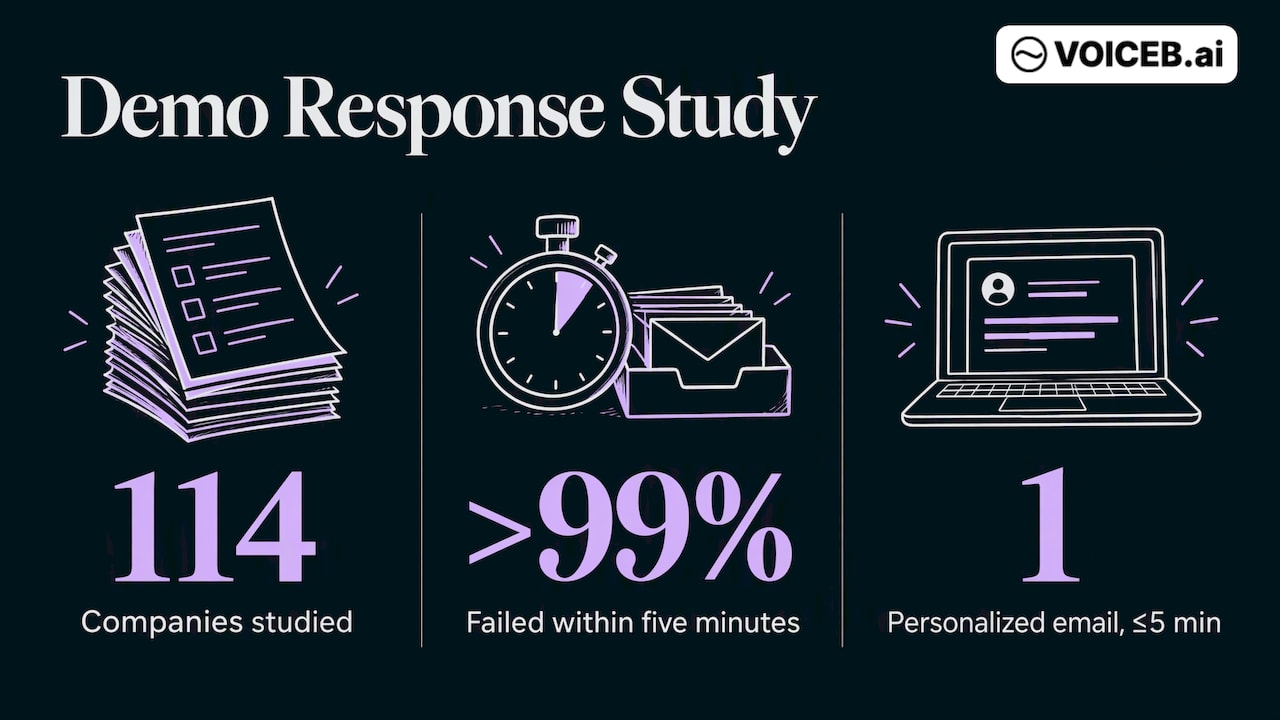
That is a vendor study of demo requests, so read it as a snapshot rather than a universal average. Still, the pattern fits what operations leaders see: the gap between the target and reality is large, and it is structural. A rep cannot answer in five minutes at 6 p.m. on a Friday, on a weekend, or during a campaign spike when 400 leads arrive in an hour.
How to measure it so the number is useful
A single average hides the problem. A handful of leads answered in two days can drag the mean up, while a fast majority masks a neglected tail. A better report set:
| Metric | What it tells you |
|---|---|
| Median time to first attempt | The typical experience |
| 90th percentile | How bad the slow tail is |
| Share attempted within 5 min, 60 min, 24 h | Whether you meet your service level |
| Share never attempted | Leakage you cannot see in an average |
| In-hours vs out-of-hours split | Whether coverage, not effort, is the issue |
| Breakdown by lead source | Where expectations should differ |
Control the time to the first response attempt. A completed first conversation depends partly on the buyer, so track it separately as a secondary outcome.
Segmenting by source matters just as much. Geckoboard notes that a demo request or sales-form inquiry is generally warmer than a content download, so each deserves its own response expectation. A pricing-page inquiry might carry a five-minute service level, while an ebook download may be fine with a same-day, nurturing-style touch. Treating them identically makes the metric misleading.
Count an automated reply correctly
An automatic acknowledgment is not a response. The cleaner rule is to count a person’s call or personal message inviting a reply as the first attempt, and to record separately any conversational automated system that actually answers questions or books an appointment. Keeping those apart stops you from declaring victory because an email template fires in two seconds.
Why response times slip: a routing problem more than a rep problem
When response time is bad, the first instinct is to coach reps. At enterprise volume, look at the system first. Typical causes:
- Assignment lag. Leads wait in a queue for a manager or a round-robin rule to fire.
- Coverage gaps. Nights, weekends, lunch hours, holidays and time zones.
- Data gaps. The rep must look up eligibility, check the CRM and configure an offer before saying anything useful.
- Spike overload. A marketing campaign or seasonal peak outruns capacity.
- Misprioritization. Hot demo requests sit behind cold downloads.
Our write-up on automated lead routing goes deeper on faster, fairer handoffs for enterprise B2B teams. Routing rules fix the assignment problem, but they cannot fix capacity: if nobody is free, a perfectly routed lead still waits.
Seven ways to improve speed to lead
- Set service levels by source and urgency. Define what “fast” means for each lead type, then report against it.
- Capture the timestamp automatically. Pull both the start and the stop event from your CRM and telephony logs, never from manual entry.
- Remove assignment delay. Route on rules that fire in seconds: territory, product, language, account ownership.
- Cover off-hours. Decide who or what engages a lead at 9 p.m. A queue until morning is a choice, and it has a cost.
- Pre-load context. Show the rep (or the automated system) the lead’s source, history and eligibility on first contact so the first message is relevant.
- Escalate misses. Alert when a lead passes the threshold with no attempt, and re-route it.
- Nurture what you cannot answer immediately. Leads that are not ready need a sequence, not silence.
Speed-to-lead automation: what to automate and what to keep human
For teams that handle thousands of inbound leads a month, the fastest path to an instant response is automation that does more than send a receipt. The useful distinction is between three levels:
| Level | What happens | Counts as a response? |
|---|---|---|
| Acknowledgment | Template email or SMS | No |
| Qualification | An automated conversation gathers needs and routes a qualified lead to a rep | Yes, record it separately |
| Execution | The system also checks eligibility, configures an offer and generates a contract | Yes, record it separately |
Most speed-to-lead tools stop at the second row. The business effect differs. Qualification alone still ends in a handoff, and the handoff is where the lead waits again for a rep. Execution removes that second wait for the leads that can be closed without a person.
Build or buy
Some enterprises consider building this in-house. Compare integration depth, maintenance load and time to value before choosing an implementation; our build-versus-buy guide explains the trade-offs.
Our perspective
We have watched enough inbound funnels to say that the five-minute rule is a symptom of a deeper principle: a lead should never wait for a human to start the process. The most expensive delay is not the one before the first reply. It is the sequence of delays after it: waiting for eligibility checks, waiting for an offer to be configured, waiting for a contract to be drafted.
That is why we built VoiceB around execution, not just qualification. Our autonomous agents hold the conversation, check customer eligibility, configure the offer and generate the contract, working across the CRM and other systems you already run. Primagas (SHV Energy) saw a 150% increase in sales volume, 250% more lead-handling capacity and a 37% reduction in cost per acquisition, with a 67.8% autonomous close rate over 12 months. Holaluz closes 30.4% of valid inbound calls autonomously and auto-filters 78% of traffic. Those are our clients’ outcomes, and yours will depend on your lead mix, product complexity and integrations.
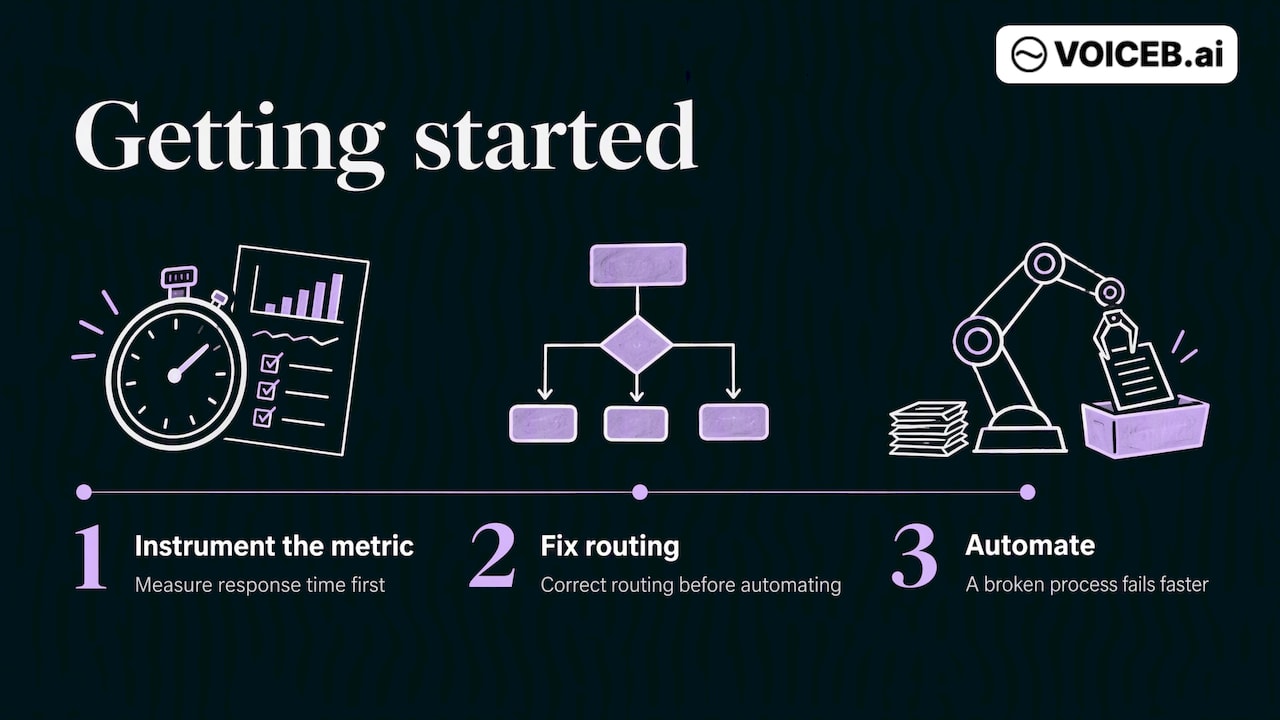
Our advice for any team starting out: instrument the metric first, fix routing second, and automate third. Automating a broken process only makes it fail faster.
— Alex Bisbe, Co-founder & CEO, VoiceB.ai
How to tell whether faster response actually pays
Speed is an input. The goal is more closed revenue at lower cost. To check that, run a before-and-after comparison on a defined segment:
- Pick one lead source with enough volume, such as pricing-page inquiries, and hold the others constant.
- Record the baseline for four to eight weeks: median and 90th-percentile response, contact rate, qualification rate, close rate, and cost per closed deal.
- Change one thing, such as off-hours coverage or automated first engagement.
- Compare the same metrics over an equal period, and account for seasonality and campaign changes.
- Include the full cost. Platform fees, integration work, rep time and any per-outcome charges against the revenue from additional closed deals.
If contact rate rises but close rate stays flat, the bottleneck has moved downstream, perhaps to offer quality or contract friction. That is a useful finding, not a failure.
What this looks like with VoiceB
Every VoiceB deployment runs on Autonomous Sales Voice Agents (ASVA), and every conversation is classified by the Outcome Engine: a deterministic, auditable classification that assigns one of four outcomes, Invalid, Qualified Transfer, Sold or Closed. See how this works in production in our case studies for Primagas (SHV Energy) and Holaluz.
Autonomous agents own the routine inbound sale end to end, from first response through eligibility, offer configuration and contract generation; humans handle genuine exceptions outside approved rules.
If your team receives 1,000 or more inbound leads a month, Autonomous Sales handles the conversation through to a completed contract, and our inbound sales automation page explains how it fits into your systems. If you only need to qualify and transfer, AI lead qualification is the narrower option. For leads already sitting in your CRM, the AI Reactivation Module re-engages them.
Pricing is built around outcomes. Published fees include a Qualified Transfer from €1.50, a Sold outcome from €7 and a Closed outcome from €15, each one-off, plus custom integrations at €900 per day. Plan details are on the pricing page, and the pay-per-outcome model is explained separately. Industry teams can also see how this works in energy, utilities and automotive.
FAQ
What is the five-minute rule for leads?
It is the guideline that you should attempt contact with a new web lead within five minutes. It rests on a 2007 study in which calling within five minutes made contact and qualification far more likely than waiting 30 minutes. Treat the multiples as directional and attribute them to that study.
How quickly should you respond to a lead?
Aim for minutes on high-intent sources such as demo and pricing requests, and set a looser service level for low-intent sources such as content downloads. What matters is a defined target per source, measured on the first genuine attempt. Track the 90th percentile as well, so slow outliers do not hide.
Does an auto-reply count as a response?
No. A template acknowledgment confirms receipt but does not engage the lead. Count a call or personal message as the first attempt, and log a conversational automated reply that answers questions or books a meeting as its own category.
How do you calculate lead response time?
Subtract the lead’s submission timestamp from the timestamp of your first genuine attempt, then average across leads: the sum of response times divided by the number of contacts. Report the median and 90th percentile alongside it, and segment by source and by business hours.