

Sales Workflow Automation: A Practical Guide for Enterprise Teams
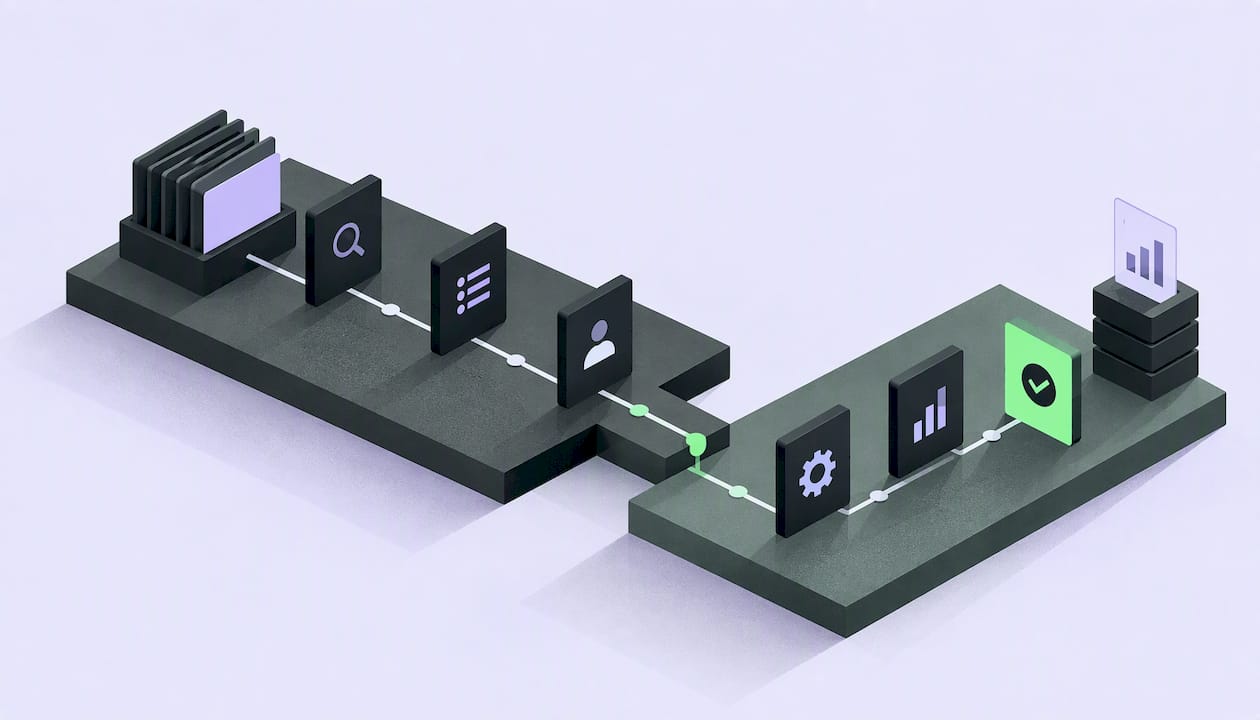
Sales workflow automation means turning the repeatable steps between a lead’s first contact and a signed contract into rules and systems that run without manual effort: routing, follow-ups, eligibility checks, offer configuration, and contract generation. For most teams the first wave is task automation inside the CRM. For enterprises with thousands of inbound leads a month, the next wave is autonomous execution, where AI agents carry a conversation through to a closed sale. This guide covers both, with the steps, examples, and governance decisions that determine whether automation pays off.
TL;DR
- A sales workflow is the ordered set of steps from lead capture to closed contract. Automate the atomic, rules-based steps first, then the conversations around them.
- Speed matters: only 31.5% of sales organizations respond to inbound leads within five minutes, and 39% of website conversations happen outside 9-5 hours.
- Tools fall into three types: CRM-native automation, integration platforms, and autonomous AI sales agents. Pick by lead volume and by how much of the workflow must be executed, not just triggered.
- Define human exception handling before deployment. Autonomous agents own the routine inbound sale end to end; humans step in for negotiations or decisions outside approved rules.
- Measure outcomes (qualified transfers, sold, closed), not activity volume.
Table of Contents
- What a sales workflow is, and what automation changes
- Sales workflow examples worth automating first
- Three types of sales workflow automation tools
- How to choose the best sales workflow automation for your team
- Where humans stay in the loop
- A step-by-step rollout
- Beyond routine tasks: agentic workflows
- Our perspective: execution, not just qualification
- How VoiceB fits into your sales workflow
- Measuring whether your automation works
- Common mistakes to avoid
- FAQ
- Sources
What a sales workflow is, and what automation changes
A sales workflow is the sequence of steps a lead moves through: capture, qualification, eligibility check, offer, objection handling, contract, and handoff to fulfillment. Each step has an owner, an input, a decision, and an output. In a manual process the owner is a person, and the transition between steps depends on someone noticing that the previous step finished.
Automation changes two things. It removes the waiting between steps, and it removes the human from steps that follow clear rules. The cost of the waiting is real. McKinsey found that non-selling activities still consume two-thirds of the average sales team’s time, and that top-quartile companies using sales automation and AI report roughly a 30% improvement in sales productivity.
Task automation versus workflow execution
These two are often confused, and the difference decides what ROI you can expect.
| Task automation | Workflow execution | |
|---|---|---|
| What it does | Triggers an action when a condition is met (send an email, create a task, assign an owner) | Carries a lead through multiple steps, holding the conversation and making decisions |
| Who finishes the sale | A human rep | The system, with humans for defined exceptions |
| Typical examples | Lead routing, follow-up sequences, reminders | Eligibility checks, offer configuration, contract generation |
| Main limit | Still depends on rep availability | Depends on integration depth and governance design |
McKinsey describes the same shift: AI in sales is moving from basic automation of administrative tasks toward agentic AI that can reason, decide next-best actions, and manage multi-channel customer journeys on its own.
Sales workflow examples worth automating first
Start with steps that are frequent, rules-based, and costly when delayed. Gartner’s research points to the same principle: high-growth teams focus on granular actions, the specific atomic steps that AI can trigger or assist, rather than automating an entire flow blindly.
1. Lead capture and routing
When a form, call, or chat arrives, the system enriches the record, deduplicates it against the CRM, and assigns it by territory, product line, or language. This is the simplest automation and the one most teams already run.
2. Speed-to-lead response
The average sales organization reaches out to a lead 8 to 12 times, yet only 31.5% respond to inbound leads within the five-minute window that maximizes conversion probability. An automated first response, ideally a real conversation and not an auto-reply, closes that gap.
3. Qualification
Qualification questions are scripted and the answers map to fields in your CRM. Automating this step means every lead is scored on the same criteria, at any hour. See how this works for voice in our guide to an AI voice agent for lead qualification at scale.
4. Eligibility checks
In telecom, energy, insurance, and automotive, a sale cannot proceed until the customer’s eligibility is verified against coverage, credit, tariff, or product rules. A human doing this in a back-office tool adds minutes or days. An agent connected to those systems can do it during the conversation.
5. Offer configuration and contract generation
Once a customer is eligible, the offer is assembled from product rules, pricing, and promotions, then the contract is generated and sent for signature. These are deterministic steps, which makes them strong automation candidates.
6. Follow-up and reactivation
Leads that go quiet and old CRM records with unconverted interest are recoverable revenue. A cadence of timed, personalized contacts, run by an agent that can hold a conversation, turns that dormant data into pipeline. Our AI Reactivation Module is built for this case.
Three types of sales workflow automation tools
Searches for sales process automation tools and top sales automation software return long lists. It is more useful to sort tools by what they do, because most stacks need more than one type.
- CRM-native automation. Rules inside your CRM that update fields, assign tasks, and send templated emails. Low setup effort, limited to what the CRM can see.
- Integration and orchestration platforms. Tools that connect applications and move data between them for routing, proposal management and CRM updates. Flexible, but you design and maintain every flow.
- Autonomous AI sales agents. Agents that speak with the lead, query your systems, configure the offer, and generate the contract. They execute the workflow rather than trigger parts of it.
One caution from McKinsey applies to all three: leaders should integrate AI tools into a single, intuitive seller experience instead of adding fragmented applications to the stack. Gartner also notes that half of sales development organizations already run five or more technology applications, so consolidation is a legitimate selection criterion.
How to choose the best sales workflow automation for your team
Use criteria, not feature lists.
- Lead volume. Under a few hundred leads a month, CRM-native rules usually suffice. Above 1,000 inbound leads a month, response time and rep capacity become the bottleneck, and autonomous execution starts to pay back.
- Workflow depth. If a sale requires eligibility checks, offer configuration, and a contract, tools that only trigger emails leave the hard steps manual.
- Integration with existing systems. The agent has to read and write to your CRM, billing, and eligibility sources. Ask what integration work is needed and how it is priced.
- Channel coverage. Inbound leads arrive by phone, web, and messaging. A workflow that handles only email misses the channels where buyers are ready to talk.
- Governance controls. You need to define what the system may decide alone, what it must escalate, and how you audit it.
- Pricing model. Per-seat pricing rewards headcount. Outcome-based pricing aligns cost with results.
Where humans stay in the loop
Automation does not mean removing people from every step. The NIST AI Risk Management Framework states that human roles and responsibilities in overseeing AI systems need to be clearly defined, and that human-AI configurations can span from fully autonomous to fully manual. Gartner and NIST both point to the same governance practice: map where and how AI acts, measure performance, and define the human role in decisions, so that bias and opaque interactions do not erode customer trust.
In practice, document a decision table during design:
| Step | Suggested configuration | Why |
|---|---|---|
| Standard eligibility check | Fully autonomous | Rules-based, auditable, high volume |
| Offer configuration within approved pricing | Autonomous, with logged rationale | Deterministic inside set limits |
| Contract generation and send | Autonomous, with template controls | Repeatable, easy to verify |
| Non-standard discounts | Human approval | Commercial risk |
| High-value negotiation | Human-led | Judgment and relationship |
| Complaints or vulnerable customers | Human escalation | Trust and compliance |
This mirrors the idea that different decision tasks need different human-AI configurations, with full oversight for high-value negotiations and autonomy for standard checks. Our platform autonomy levels, L1 to L4, formalize this choice, and Agent Studio is where you build and govern the agents’ behavior.
A step-by-step rollout
- Map the current workflow. List every step from first contact to signed contract, with owner, system, average time, and drop-off rate.
- Find the delays. Look for hand-offs, queues, and after-hours gaps. Around 41% of meetings are booked outside standard working hours in a 2024 analysis of 30 million conversations, so a process that sleeps at 5 p.m. loses demand.
- Classify each step. Mark it as rules-based, judgment-based, or relationship-based. Automate the first group first.
- Define human-in-the-loop rules. Write them down before build, as in the table above.
- Integrate before you automate. Connect CRM, eligibility sources, pricing, and contract tooling. Missing integration pushes work back to reps. McKinsey warns that underinvesting in support functions simply pushes administrative burdens back onto sellers.
- Pilot on one segment. Choose one product line or region with enough volume to read results within weeks.
- Measure outcomes. Track response time, qualified transfers, sold, and closed contracts, plus cost per acquisition.
- Expand. Add channels, products, and reactivation campaigns once the pilot’s numbers hold.
For an internal business case, measure waiting time, manual touchpoints, lead-handling capacity and completed sales against your own baseline.
Beyond routine tasks: agentic workflows
The earlier generation of automation handled administration: logging calls, updating fields and scheduling. Autonomous agents coordinate and execute the inbound sale itself, deciding what to ask, what to check and which approved offer to present, then completing the contract. Humans handle genuine exceptions outside approved rules.
For a deeper look at the types of agents and what decides their return, read our breakdown of AI sales agents and why enterprise workflows decide the ROI, and our piece on autonomous sales agents for enterprise and the three stages to CRM action.
Our perspective: execution, not just qualification
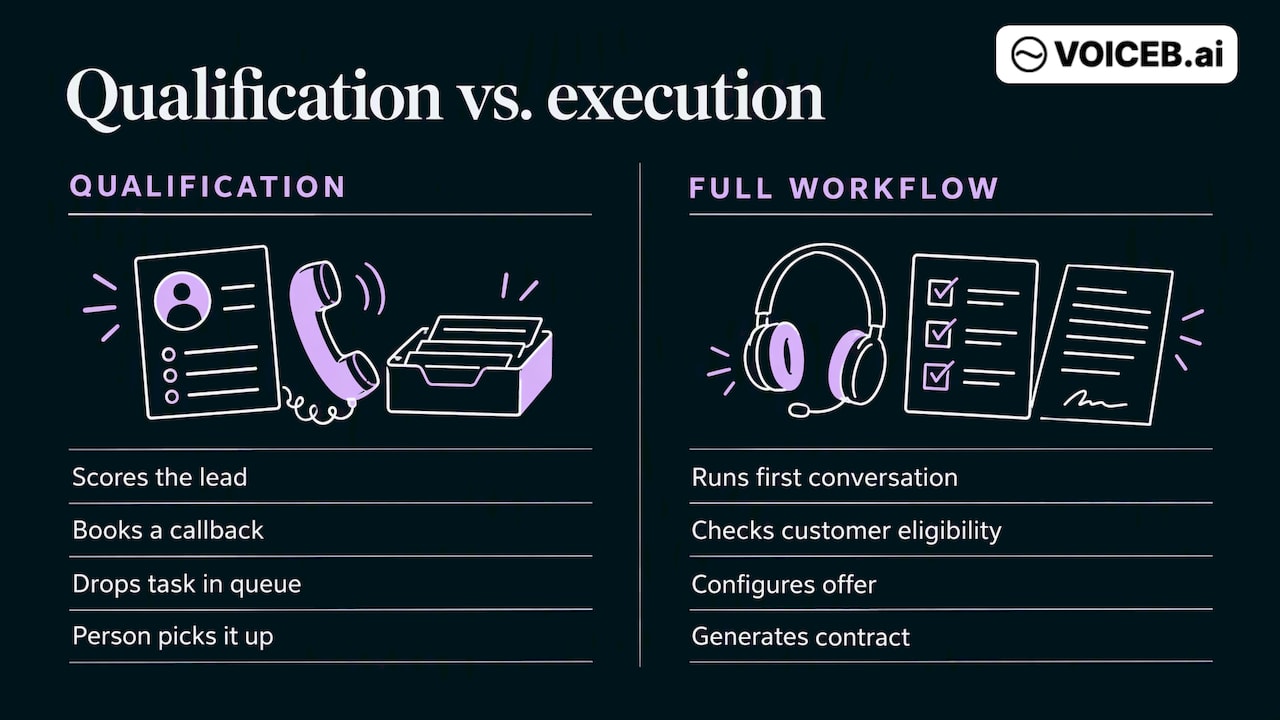
We built VoiceB around one observation: most automation stops one step before revenue. It scores the lead, books a callback, or drops a task in a queue, and then a person has to pick it up. The delay and the manual touchpoints are exactly where inbound demand leaks.
So our agents run the whole inbound workflow: the first conversation, the customer eligibility check, offer configuration, and contract generation, operating across your existing systems. The point is that an interaction ends in a result, not in a ticket.
We also think autonomy should be earned in stages. Start with the steps that are rules-based and auditable, set the escalation rules explicitly, and widen scope as the numbers justify it. Technology alone is not the answer; process design and integration quality determine whether the capacity gains are real.
Primagas (SHV Energy) saw a 150% increase in sales volume, 250% more lead-handling capacity and a 37% reduction in cost per acquisition, with a 67.8% autonomous close rate over 12 months. Holaluz closes 30.4% of valid inbound calls autonomously and auto-filters 78% of traffic. You can read the energy case on our energy industry page. Results depend on lead volume, integration depth, and workflow design, so we scope each deployment against your own baseline.
— Alex Bisbe, Co-founder & CEO, VoiceB.ai
How VoiceB fits into your sales workflow
Every VoiceB deployment runs on Autonomous Sales Voice Agents (ASVA), and every conversation is classified by the Outcome Engine: a deterministic, auditable classification that assigns one of four outcomes, Invalid, Qualified Transfer, Sold or Closed. See how this works in production in our case studies for Primagas (SHV Energy) and Holaluz.
Autonomous agents own the routine inbound sale end to end, from first response through eligibility, offer configuration and contract generation; humans handle genuine exceptions outside approved rules.
If your team handles thousands of inbound leads a month, Autonomous Sales is the offer built for this workflow: agents that manage the conversation through to a generated contract. If you need to start with qualification only, AI Lead Qualification covers that step.
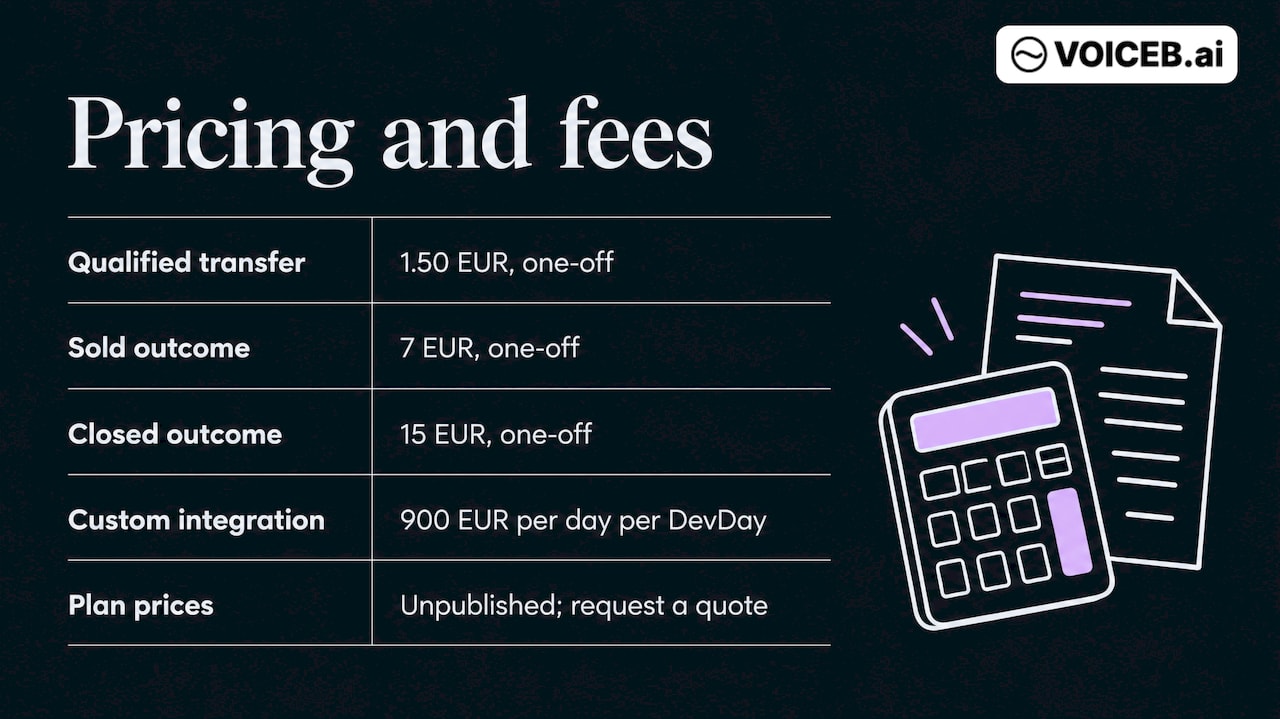
Pricing follows outcomes. Published fees on our pricing page include a Qualified Transfer from 1.50 EUR one-off, a Sold outcome from 7 EUR one-off, and a Closed outcome from 15 EUR one-off. Custom integrations are 900 EUR per day per DevDay. Plan prices for Starter, Enterprise, and Corporate Custom are not published, so contact us for a quote based on your volume. The outcome-based model means you pay when the workflow produces a result.
Measuring whether your automation works
Many teams track activity: emails sent, calls placed, tasks completed. Gartner’s research cautions against focusing on generic metrics like touch volume. Track what the workflow is for:
- Speed to first response, against the five-minute benchmark.
- Qualified transfer rate, the share of leads handed to a person or next stage with complete data.
- Sold and closed rate, by segment and channel.
- Cost per acquisition, including agent, integration, and rep time.
- Escalation rate and reasons, which show where rules need refining.
- Customer experience signals, such as wait time and complaint rate.
McKinsey advises leaders to focus first on productivity gains, because revenue impact depends on how effectively sellers activate the insights AI surfaces. Run your baseline for a month before launch so the comparison is honest. For a head-to-head view, see AI voice agents versus human sales teams on ROI, cost, and speed.
Common mistakes to avoid
- Automating a broken process. If the manual workflow has unclear ownership, automation speeds up the confusion.
- Adding tools without consolidation. Every extra app is another screen for sellers and another integration to maintain.
- Skipping the human-in-the-loop design. Undefined escalation produces either risky autonomy or constant manual review.
- Measuring activity instead of outcomes. More touches do not mean more contracts.
- Ignoring after-hours demand. If a large share of buyer interaction happens outside the workday, coverage hours are a conversion issue.
FAQ
How do you automate a sales process?
Map each step from lead capture to contract, classify steps as rules-based or judgment-based, and automate the rules-based ones first. Integrate your CRM and other systems so data moves without re-entry, then pilot on one segment and measure outcomes. Add autonomous conversation handling when volume makes rep capacity the bottleneck.
What is a sales workflow?
It is the defined sequence of steps a lead follows from first contact to closed contract, including qualification, eligibility checks, offer, and signature. Each step has an owner, inputs, and a decision. Automation assigns some of those owners to software.
What is the difference between sales automation and an autonomous sales agent?
Sales automation triggers actions, such as emails or tasks, when conditions are met, and a rep still finishes the sale. An autonomous sales agent holds the conversation, checks eligibility, configures the offer, and generates the contract, escalating to people only for defined exceptions.
Which sales workflow steps should stay with humans?
Keep high-value negotiations, non-standard discounts, and sensitive customer situations with people. Standard eligibility checks and offer configuration within approved limits are good candidates for autonomy. Write these rules down during design, as NIST guidance on human-AI configurations recommends.
Is sales workflow automation only for large enterprises?
Smaller teams benefit from CRM-native rules and integration tools. Autonomous execution is most valuable where inbound volume is high, typically above 1,000 leads a month in sectors like telecom, energy, and insurance, because that is where response time and rep capacity limit revenue.
Sources
- Gartner: The Role of Artificial Intelligence in Sales
- McKinsey: How top performers outpace peers in sales productivity
- McKinsey: Marketing and sales soar with generative AI
- McKinsey: Looking beyond technology to drive sales operations
- Gartner Peer Community: Drift conversational AI research on 30 million conversations
- Gartner: 11 Sales Development Strategies for High-Growth Companies
- NIST AI RMF: AI Risk Management and Human-AI Interaction