

Lead Enrichment AI: How It Works and Where It Pays Off
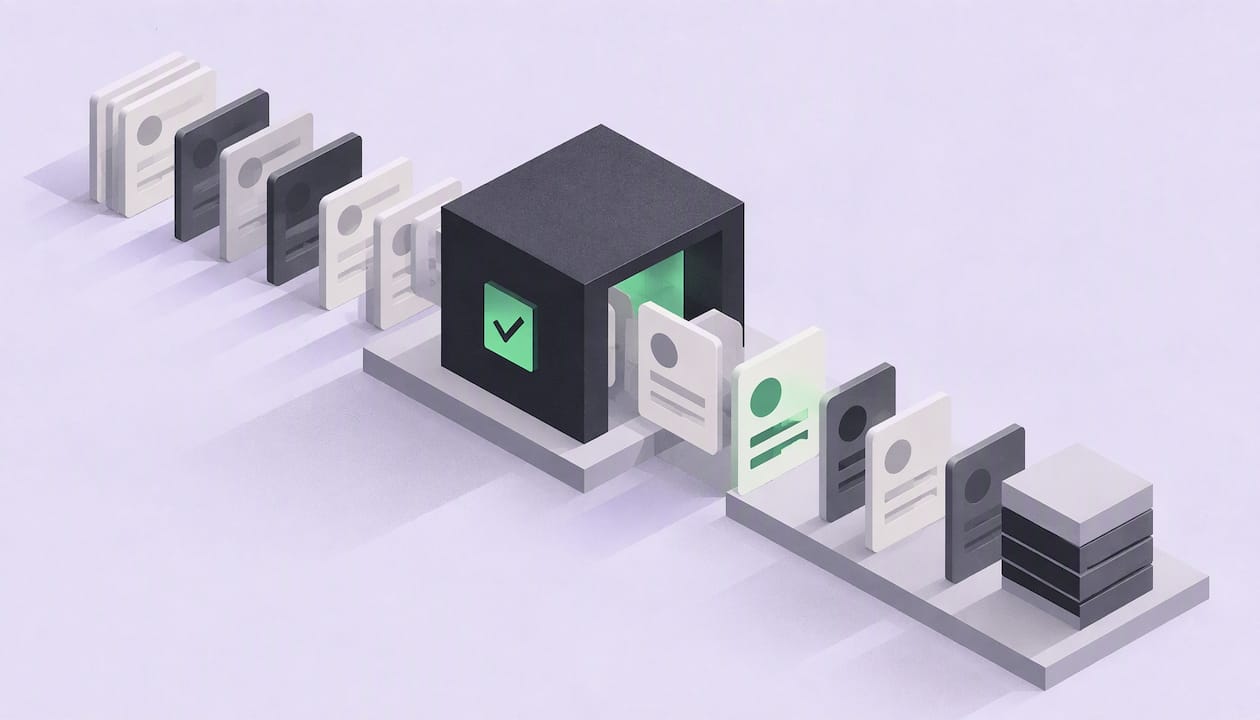
Lead enrichment AI fills in the gaps of an inbound lead record (company, role, need, eligibility, documents) and checks that what it adds is correct, so your team acts on complete data instead of a name and an email. For enterprises handling thousands of inbound leads a month, the value is not the extra fields. It is what happens next: faster routing, cleaner CRM records and offers configured on verified facts.
This guide covers what AI changes compared with traditional enrichment, what data it can add, how real-time validation works, how document capture feeds lead records, and how to measure the result.
TL;DR
- AI lead enrichment automatically completes, verifies and updates lead records at the moment a lead arrives, instead of in periodic list clean-ups.
- The data that matters most for inbound sales often comes from the conversation and the customer’s documents, not only from third-party databases.
- Validation should run at the point of entry, with batch jobs as a safety net for duplicates and drift.
- Measure it with a before-and-after baseline: field completeness, duplicate rate, time to first response, cost per acquired customer and conversion.
- Enrichment pays off most when it connects to action: qualification, offer configuration and contract generation.
Table of Contents
- What lead enrichment AI means
- What AI can add to an inbound lead record
- How real-time data validation works
- Where AI enrichment can go wrong
- Document capture: the overlooked half of enrichment
- From enriched data to sales documents
- Perspective: enrichment should end in action
- How to measure whether AI enrichment works
- A practical implementation sequence
- How VoiceB prices the work
- FAQ
- Sources
What lead enrichment AI means
Traditional lead enrichment appends data to a record: you send an email address or domain to a data source and get back company size, industry, location or job title. It is useful, but it is a lookup. Someone still has to decide what the data means and what to do with it.
AI lead enrichment adds three capabilities on top of the lookup:
- Interpretation. Language models read unstructured input (a call transcript, a web form’s free-text box, an email, an attached bill) and turn it into structured fields.
- Verification. The system compares what the lead says with what other sources say and flags conflicts instead of silently overwriting.
- Continuity. Records are updated as new information arrives, so the CRM reflects the lead’s current situation rather than a snapshot from the day of import.
The practical difference: a traditional tool tells you a company has 800 employees. An AI-driven workflow also learns, from the conversation, that the prospect’s contract ends in 60 days and that they need three sites covered. That second kind of data is what turns a lead into an offer.
What AI can add to an inbound lead record
Think of enrichment data in four layers. Each has different sources and different reliability.
| Layer | Examples | Typical source | Reliability risk |
|---|---|---|---|
| Identity and contact | Verified email, phone, role, company name | Form input, CRM history, validation checks | Typos, disposable addresses, outdated roles |
| Company context | Industry, size, locations, technology in use | Public company information, licensed data sources | Stale data after mergers or growth |
| Intent and need | Product interest, timeline, current provider, budget range | The conversation itself, web behavior | Misheard or inferred answers |
| Eligibility and documents | Service availability, credit or coverage checks, ID or invoice data | Internal systems, uploaded documents | Extraction errors, incomplete uploads |
Most articles on this topic stop at the first two layers, because those are what database tools sell. In enterprise inbound sales, layers three and four decide whether a lead can be converted without a handoff. If an AI agent already knows the customer’s eligibility and has captured the right document fields, it can configure an offer in the same interaction.
That is the design principle behind our AI lead qualification: qualification is not a score attached to a record, it is the collection and checking of exactly the facts needed to move to the next step.
How real-time data validation works
Enrichment is only as good as the validation behind it. There are two operating modes, and mature setups use both.
Real time. Oracle’s documentation describes the model clearly: cleansing and matching run when an account, contact or prospective-contact record is saved. The bad value is caught before it spreads into routing rules, reports and outreach.
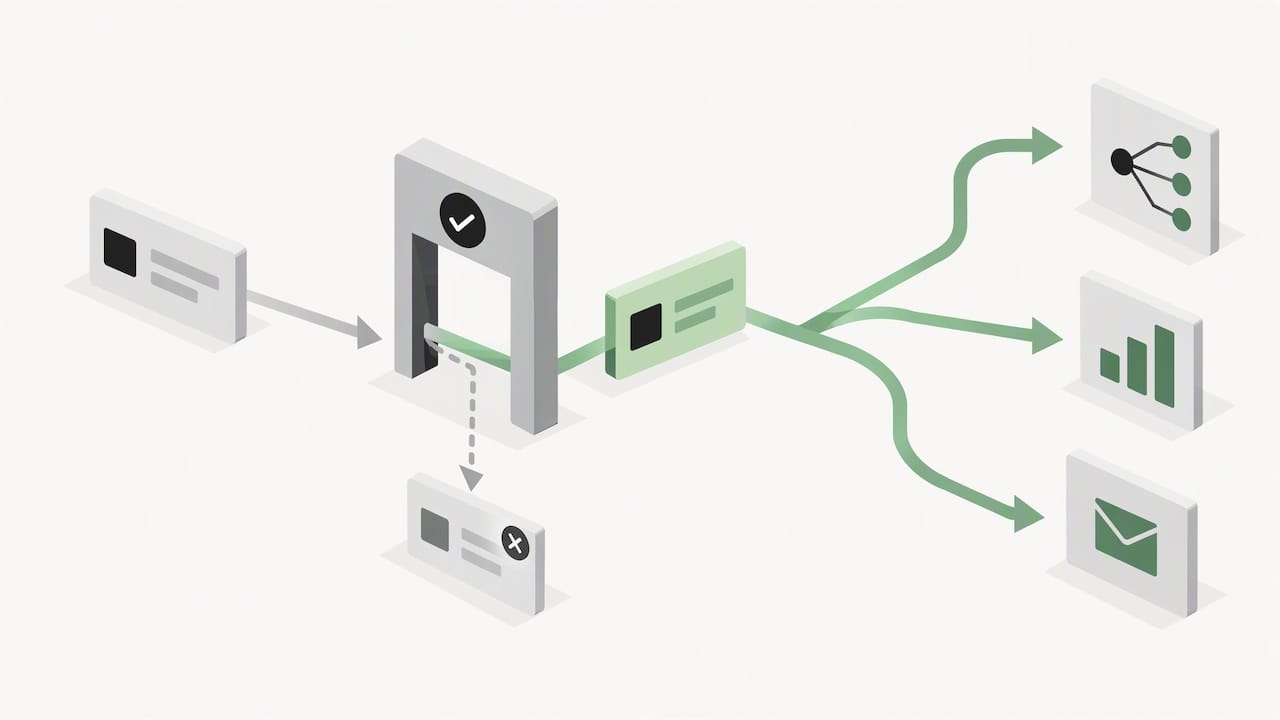
Batch. The same documentation describes batch jobs that standardize fields and identify possible duplicates for data stewards to resolve. Batch catches what real time cannot: records that were fine when saved and drifted later, and duplicates created across systems.
A real-time enrichment flow runs in a consistent sequence:
- Capture the data as it is entered.
- Check it against rules, formats and reference sources.
- Flag or correct issues immediately.
- Apply matching to prevent duplicates.
- Store the standardized record.
For an inbound sales team, translate that into concrete rules:
- Phone and email formats are normalized and tested for plausibility before the lead is routed.
- Company names are matched against existing accounts, so a returning customer is not treated as a new lead.
- Values given verbally by the lead are confirmed back to them and stored with the source noted (“stated by customer” versus “retrieved from system”).
- Anything that fails a check goes to a review queue rather than into the contract.
The data quality dimensions to test against
The Data Management Association defines high-quality data as accurate, complete, consistent, timely, unique and valid. IBM adds a seventh, homogeneity, which addresses harmonizing fragmented enterprise data so AI systems interpret it consistently. Homogeneity matters if your leads arrive through several channels and each writes “Spain”, “ES” and “España” differently.
Use these seven as an audit checklist. For each, pick one field that drives revenue (say, service address or contract end date) and test it.
Where AI enrichment can go wrong
AI adds speed, and it adds a new failure mode: confident wrong answers. Research on retrieval-augmented language models, the ReEval study, found that they can produce unsupported answers when the evidence they retrieve is perturbed. In a sales context that means an enrichment step can state something plausible that no source supports.
Three controls reduce this risk:
- Require provenance. Every enriched field stores where it came from. A field with no source is not written to the CRM as fact.
- Separate stated from verified. What a lead says and what a system confirms live in different fields or carry different status flags.
- Gate high-stakes actions. Anything that touches pricing, eligibility or a contract reads only verified fields.
Privacy is the other constraint. Enrichment from third-party sources can pull personal data your company never collected directly, so involve legal and privacy teams before you switch it on. Define which fields you are allowed to append, how long you retain them, and how a person can have them corrected or deleted under the laws that apply in each country you sell in. Requirements differ between, for example, US state laws and the EU’s rules, so do not assume one policy covers every market.
Document capture: the overlooked half of enrichment
In many enterprise sales flows, the richest data is not in a database. It is in the documents a customer sends: a recent invoice, an ID, a quote request, a signed form. Document capture automation reads these files and writes the contents into the lead record.
Microsoft’s document extraction service, for instance, returns extracted field values along with confidence scores. The confidence score is the key design element. It lets you set thresholds:
- High confidence: write the value to the record automatically.
- Medium confidence: ask the customer to confirm it in the conversation.
- Low confidence: route to a person or request a clearer upload.
This is the same logic as real-time validation, applied to files. The workflow looks like this:
- The customer uploads or sends a document during the interaction.
- Fields are extracted with confidence scores.
- Extracted values are validated against format rules and against what the customer already stated.
- Mismatches are resolved in the conversation, while the customer is still engaged.
- Verified values populate the lead record and feed the offer.
Collecting documents mid-conversation, rather than in a follow-up email, is where the biggest time savings tend to sit. A lead who is asked for a document three days later often never sends it.
From enriched data to sales documents
Sales document automation is the downstream use of all this data: quotes, proposals, order forms and contracts generated from verified fields instead of retyped by a person. Its quality depends entirely on the quality of enrichment upstream. A contract template filled from unverified data multiplies errors instead of removing them.
In a well-built flow, the same verified record drives each step:
- Eligibility check: can this customer be served at this address, on this product?
- Offer configuration: which plan, term and options fit the stated need?
- Contract generation: the document is populated from the verified fields, with a clear audit trail of where each value came from.
This is the end-to-end pattern behind autonomous sales: the agent does not stop at tagging a lead as qualified, it carries the verified data through to a completed contract inside your existing systems.
Perspective: enrichment should end in action
We see many enterprises invest in enrichment and still lose revenue, because the enriched record sits in a CRM waiting for a person to act on it. A richer profile does not close a sale. A completed workflow does.
Our view is that enrichment, validation and execution belong in a single flow. When an AI agent speaks with a lead, it can collect the missing facts, check them against your systems, and move straight to configuring an offer. There is no gap between “data complete” and “next step” in which the lead goes cold. That is why we build agents that execute sales tasks, rather than only attach data to leads.
The same logic applies to the leads already in your database. Records that went quiet often hold the data needed to re-engage them. Our reactivation module revisits those contacts, refreshes what is outdated and brings the ones that are still interested back into the workflow. Primagas (SHV Energy) saw a 150% increase in sales volume, 250% more lead-handling capacity and a 37% reduction in cost per acquisition, with a 67.8% autonomous close rate over 12 months. Holaluz closes 30.4% of valid inbound calls autonomously and auto-filters 78% of traffic.
The discipline we recommend is simple: never let a field reach a contract unless you know where it came from.
— Alex Bisbe, Co-founder & CEO, VoiceB.ai
How to measure whether AI enrichment works
Set a baseline for 30 days before you change anything, then compare. Track metrics in four groups.
Data quality
- Field completeness on the 10 to 15 fields your sales process depends on.
- Duplicate rate among new leads.
- Validation failure rate at entry, and how many failures were corrected versus dropped.
- Accuracy by sample: have a person check 100 random enriched records each month against the original source.
Speed
- Time to first response from lead creation.
- Time to qualified decision: how long until you know whether the lead is eligible and interested.
- Manual touchpoints per lead from first contact to signed contract.
Cost
- Cost per qualified lead and cost per acquired customer.
- Hours spent on manual data entry and clean-up.
Conversion
- Lead-to-qualified, qualified-to-sold and sold-to-closed rates.
- Drop-off points in the flow, especially at document collection.
A caution on attribution: if you change routing, scripts and enrichment at once, you cannot tell which one moved the numbers. Roll out in stages, or hold out a control group of leads processed the old way.
For routing specifically, see how automated lead routing depends on the completeness of the data in each record.
A practical implementation sequence
- Pick one lead source with enough volume to measure, ideally 1,000 or more leads a month.
- Define the required fields for each stage, from first contact to contract.
- Write validation rules for each field and decide what happens on failure.
- Connect your systems: CRM, eligibility sources, document storage and contract tools. Integration is usually the longest part of the project.
- Set confidence thresholds for automatic writes, confirmations and human review.
- Run a pilot, measure against the baseline, then expand to more sources and products.
Common obstacles are predictable: legacy systems with no clean API, inconsistent field definitions between teams, and unclear ownership of data quality. Name an owner for each before launch.
How VoiceB prices the work
Every VoiceB deployment runs on Autonomous Sales Voice Agents (ASVA), and every conversation is classified by the Outcome Engine: a deterministic, auditable classification that assigns one of four outcomes, Invalid, Qualified Transfer, Sold or Closed. See how this works in production in our case studies for Primagas (SHV Energy) and Holaluz.
Autonomous agents own the routine inbound sale end to end, from first response through eligibility, offer configuration and contract generation; humans handle genuine exceptions outside approved rules.
We price around outcomes, not seats alone. Our pricing page lists the Starter, Enterprise and Corporate Custom plans, plus the Reactivation Module, and plan prices are not published. Published outcome-based fees start at €1.50 for a qualified transfer, €7 for a sold lead and €15 for a closed one. Custom integrations are billed at €900 per day per DevDay. If your lead volume is high and your data lives across several systems, talk to us about autonomous inbound sales and we will map the flow to your stack.
FAQ
What is the difference between lead enrichment and lead qualification?
Enrichment adds and verifies data on a record. Qualification decides whether the lead is a fit and ready to buy. In practice they overlap: the facts needed to qualify a lead are often the facts enrichment collects, which is why combining them in one flow is faster than running them separately.
Can AI enrich leads in real time?
Yes. Validation and matching can run at the moment a record is saved, and an AI agent can collect missing facts during the conversation itself. Batch jobs are still useful afterward to catch duplicates and stale values.
How accurate is AI-enriched data?
It depends on the source and the controls around it. Language models can state unsupported answers, so store the source of every field, separate customer-stated data from system-verified data, and sample records regularly against the original source.
What data should I enrich first?
Start with the fields that block the next sales step: contact validity, company match against existing accounts, eligibility inputs and any document-derived values. Add firmographic detail later, once the core flow is reliable.
Sources
- Data Quality Modes of Operation, Oracle documentation
- Smarter data for finance agents, IBM
- ReEval: Automatic Hallucination Evaluation for Retrieval-Augmented Large Language Models
- Azure AI Document Intelligence data extraction in Salesforce, Microsoft Learn