

Generative AI for Sales: From Drafting Emails to Closing Deals
Generative AI for sales is the use of large language models to write, summarize, answer and decide inside the selling process. For most teams it started as a drafting tool for emails and call notes. For enterprises with thousands of inbound leads a month, the larger return now comes from letting AI agents execute the workflow itself: the conversation, the eligibility check, the offer and the contract. This guide covers both layers, what the evidence supports, what can go wrong, and how to evaluate a deployment.
TL;DR
- Generative AI in sales works at three levels: assisting a seller, automating individual tasks, and autonomously running a workflow end to end.
- Clean, structured CRM data is the binding constraint. Without it, offer configuration and eligibility checks produce errors.
- Enterprise buyers now expect governance: audit trails, version control and alignment with frameworks such as NIST’s AI RMF.
- For high inbound volume, pricing tied to outcomes (a qualified transfer, a sale, a closed contract) keeps cost aligned with revenue.
Table of Contents
- What generative AI does in a sales organization
- The most common use cases, and where each one pays
- Why content generation alone stalls
- From assistance to agentic execution
- What a generative sales workflow looks like step by step
- Data hygiene decides whether it works
- Governance: what enterprise procurement now asks for
- Our perspective: execution is the product
- How to evaluate generative AI for your sales team
- Where this fits by industry
- The commercial model: pay for outcomes
- Multi-channel context for your funnel
- See it on your own inbound volume
- FAQ
- Sources
What generative AI does in a sales organization
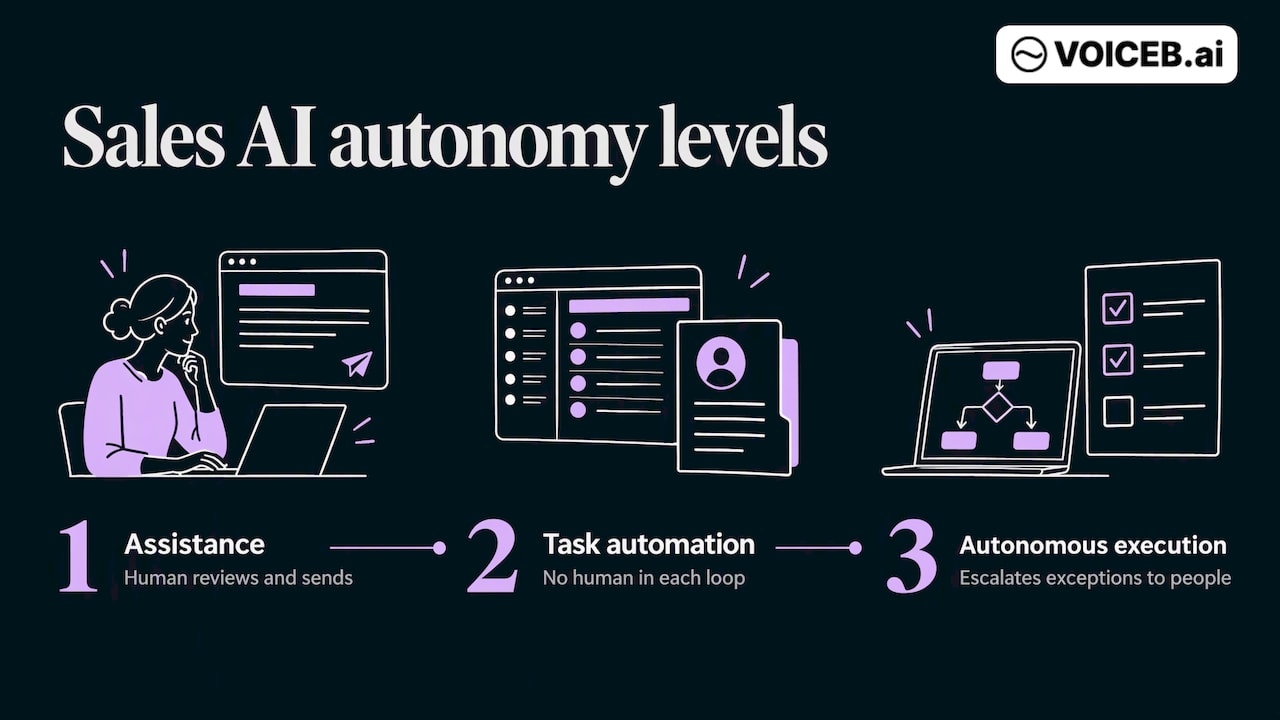
A generative model produces language and structured output from context. In sales, that context is your CRM records, product catalog, pricing rules, call transcripts and customer messages. Three levels of use are worth separating, because they have different risk profiles and different returns.
Level 1: assistance. The model drafts outreach, summarizes calls, prepares account briefs and suggests next steps. A human reviews and sends. This is where most teams begin.
Level 2: task automation. The model handles discrete tasks without a human in each loop: logging notes to the CRM, scoring and routing leads, answering common questions, scheduling meetings.
Level 3: autonomous execution. AI agents run a defined workflow from first contact to a completed outcome, operating across your existing systems and escalating to people only on exceptions. For a deeper look at how these agents differ by type, see our breakdown of AI sales agents and why enterprise workflows decide the ROI.
McKinsey frames the same progression for B2B. Its analysis maps three pathways, starting with productivity gains from task automation and extending to a reshaped selling model.
The most common use cases, and where each one pays
| Use case | Level | Typical owner | What to measure |
|---|---|---|---|
| Email and message drafting | 1 | Sales reps | Reply rate, time saved per rep |
| Call summaries and CRM notes | 1-2 | Sales ops | Field completion, admin hours |
| Lead qualification | 2-3 | Sales and ops | Qualified rate, speed to first response |
| Offer configuration and quoting | 3 | Sales ops, IT | Quote accuracy, time to quote |
| Eligibility checks | 3 | Ops, compliance | Error rate, rework |
| Contract generation | 3 | Sales ops, legal | Cycle time, completed contracts |
| Dormant lead reactivation | 2-3 | Marketing, sales | Revenue recovered from existing CRM data |
The first rows are easy to start and easy to copy, so they rarely differentiate you. The later rows touch revenue directly, but they depend on integrations and data quality.
Why content generation alone stalls
Producing more emails and sales copy is not the same as executing a sale. For high-volume inbound teams, the priority is reducing the time between customer intent and a completed outcome through autonomous execution.
There is a practical reason. A better-written email does not fix a slow handoff. If a lead fills in a form on Monday, waits for a callback on Wednesday and receives a quote on Friday, a smarter draft changes little. The bottleneck is the number of manual touchpoints between interest and signature.
The research on field results is mixed in a useful way. Randomized experiments in online retail quantified the short-term effect of generative AI on sales performance at scale, which shows the technology can move revenue in a controlled setting. But consumer retail is not a regulated, multi-step enterprise sale. For telecom, energy, insurance or automotive, the question is whether the AI can act inside your systems, not just talk.
From assistance to agentic execution
An agentic system does more than suggest. It calls tools: it reads the CRM, checks a customer against eligibility rules, configures an offer from your catalog, and generates the contract. Humans handle exceptions, not every case.
Evidence for this direction is growing, though much of it comes from vendors and small samples, so read it with care:
- An academic study of AI-first go-to-market models, The Zero-Person Sales Team, found that AI-first companies show 53% higher sales efficiency than traditional counterparts. These are company-level outcomes, not a guarantee for any single deployment.
What these numbers share is the mechanism. Gains appear where AI removes waiting and handoffs, and where it works at the moment of customer intent. A person who calls in or submits a request at 9 p.m. gets an answer in that conversation instead of the next business day.
If you want to see how that comparison plays out in cost, speed and conversion terms, we have written up AI voice agents versus human inbound sales teams.
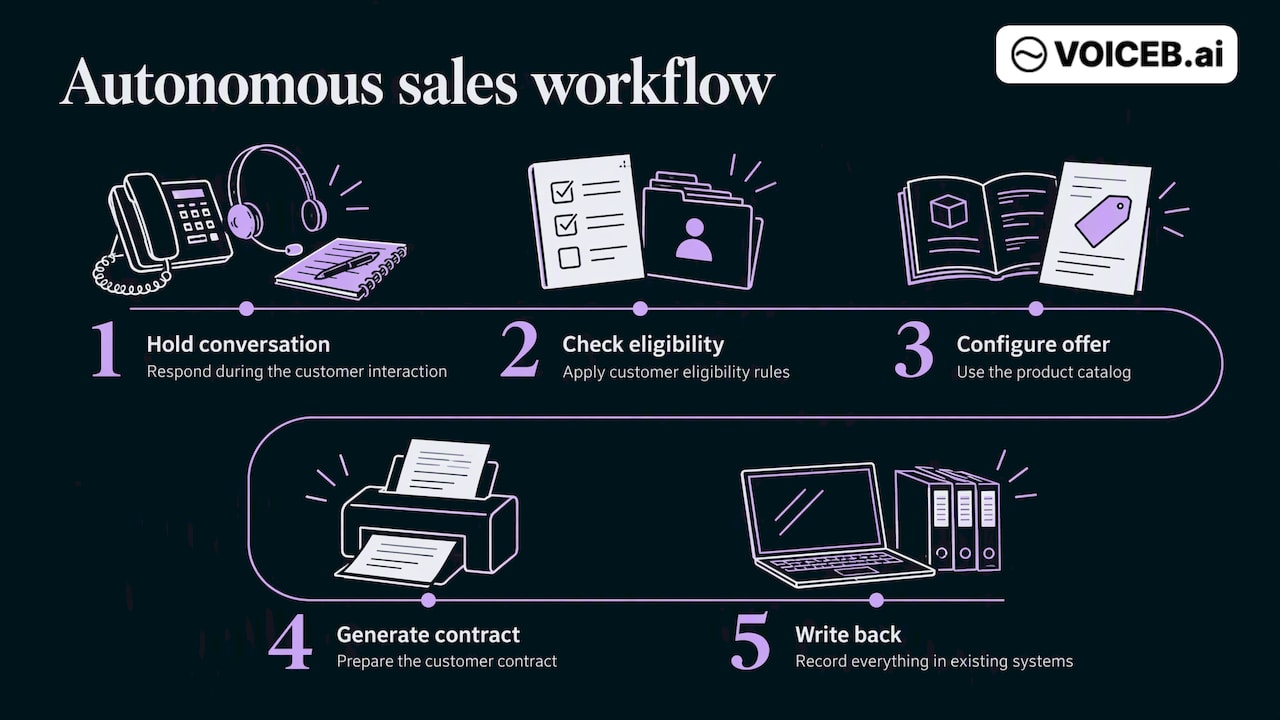
What a generative sales workflow looks like step by step
Take an inbound lead at an energy retailer, a typical high-volume case. An autonomous workflow runs like this:
- Conversation. The customer calls or responds to a campaign. The agent opens a natural conversation and captures the need.
- Identification and eligibility. The agent checks the customer against your rules and systems: coverage, credit, product fit, regulatory conditions.
- Offer configuration. It builds the offer from your live catalog and pricing, rather than inventing terms.
- Objection handling. It answers questions inside approved boundaries.
- Contract generation. It produces the contract and sends it for signature.
- Write-back. Every step is recorded in the CRM, so reporting and audit stay intact.
- Escalation. Cases outside defined boundaries go to a person with full context.
Notice that steps 2, 3 and 5 are where hallucination does damage. A model that guesses an eligibility rule or a tariff creates a legal and commercial problem. That is why the architecture around the model matters more than the model: retrieval from authoritative sources, rule checks outside the language model, and logging of every action.
Data hygiene decides whether it works
Clean, structured CRM data is a prerequisite for reliable eligibility checks and offer configuration. Treat agent deployment as an ongoing governance and evaluation process, not a plug-and-play event.
Before a pilot, audit five things:
- Duplicates and stale records. Which accounts and contacts are current?
- Field consistency. Are product, status and consent fields filled in a standard way?
- Rule documentation. Can eligibility and pricing rules be written as explicit logic?
- Consent and contact permissions. Do you know who you may contact, by which channel?
- System access. Which APIs expose the data the agent needs to read and write?
This audit is also where a dormant database turns into an opportunity. Records that were never worked, or leads that went cold, can be re-engaged. Our AI Reactivation Module is built for recovering revenue already sitting in your CRM.
Governance: what enterprise procurement now asks for
If you sell or buy generative AI in an enterprise, expect a security and compliance review early. Two reference points matter for a U.S. buyer.
First, use NIST’s AI Risk Management Framework and its Generative AI Profile (NIST-AI-600-1) to identify and manage risks. These are voluntary guidance, not certification or law; check the current version.
Second, regulation abroad. If you sell to or operate in Europe, the same checklist source points to the EU AI Act for binding obligations on high-risk systems. Whether your use case counts as high-risk depends on the application, so confirm it with counsel rather than assuming.
An AI sales compliance program needs regulatory controls, technical safeguards, governance and assurance. Maintain traceable audit logs and model versions so each outcome can be reviewed.
In practice, ask any vendor:
- Is every agent action logged and attributable to a model and configuration version?
- Can you set the level of autonomy per workflow, and change it?
- Where does customer data live, and who can access it?
- What happens when the agent is uncertain?
Our Agent Studio is where teams build and govern autonomous sales agents, and the platform’s autonomy levels L1 to L4 let you decide how much the agent does on its own at each stage.
Our perspective: execution is the product
Every VoiceB deployment runs on Autonomous Sales Voice Agents (ASVA), and every conversation is classified by the Outcome Engine: a deterministic, auditable classification that assigns one of four outcomes, Invalid, Qualified Transfer, Sold or Closed. See how this works in production in our case studies for Primagas (SHV Energy) and Holaluz.
Autonomous agents own the routine inbound sale end to end, from first response through eligibility, offer configuration and contract generation; humans handle genuine exceptions outside approved rules.
We build AI agents for enterprises that handle thousands of inbound leads every month. What we see is consistent: the teams that gain the most do not ask the model to write better. They ask it to finish more of the job.
Most AI in sales stops at qualification. A lead is scored, tagged and passed to a person, and the time between interest and a signed contract is still dominated by waiting. We built VoiceB to execute the workflow: hold the conversation, check eligibility, configure the offer, generate the contract, and write everything back to the systems you already use. The point is that every interaction can end in an outcome, not a task for someone else.
Primagas (SHV Energy) saw a 150% increase in sales volume, 250% more lead-handling capacity and a 37% reduction in cost per acquisition, with a 67.8% autonomous close rate over 12 months. Holaluz closes 30.4% of valid inbound calls autonomously and auto-filters 78% of traffic. Those results come from specific energy deployments, and your numbers will depend on your data, products and rules. We say so because the honest way to evaluate any agent is a pilot against your own baseline.
Do not treat labor-cost reduction as the goal. Autonomous agents own the routine inbound sale end to end; humans handle genuine exceptions outside approved rules. Start with a bounded workflow, prove the outcomes against your baseline, then widen the autonomy.
— Alex Bisbe, Co-founder & CEO, VoiceB.ai
How to evaluate generative AI for your sales team
Use criteria that separate a demo from a deployment.
- Does it act or only advise? Ask the vendor to show a lead going from first contact to a generated contract, not a dashboard.
- Does it work inside your stack? Look for CRM write-back, telephony and catalog integration. A tool that lives beside your systems adds touchpoints.
- How does it handle rules? Eligibility and pricing should come from your logic, not from model memory.
- What is the escalation design? Define when a human takes over and what context they receive.
- What does it cost per outcome? Seat-based pricing rewards activity. Outcome-based pricing rewards results.
- Can you govern it? Logs, versioning, autonomy levels and access controls should be demonstrable.
- Is the pilot measurable? Agree upfront on baseline conversion, speed to lead, acquisition cost and error rate.
If your use case is lead handling specifically, see how autonomous agents qualify leads at scale and how autonomous sales agents move through three stages to CRM action.
Where this fits by industry
The pattern is strongest where inbound volume is high, products are configurable and the sale follows rules.
- Energy and utilities: tariff comparison, eligibility and contract generation at volume. See our pages for energy and utilities.
- Insurance: qualification, quoting and policy conditions. See insurance.
- Automotive: voice-first handling of enquiries and appointment or offer progression. See automotive.
- B2B technology: inbound demo requests and SaaS qualification. See B2B tech.
If your volume is a few dozen leads a month, a Level 1 assistant is likely enough. The autonomous model earns its place around 1,000 or more inbound leads monthly, where waiting time and manual touchpoints compound.
The commercial model: pay for outcomes
Generative AI pricing often follows seats or usage, which can leave you paying whether or not revenue arrives. We publish an outcome-based structure so cost tracks results. On our pricing page the one-off outcome fees start at:
| Outcome | Fee |
|---|---|
| Qualified Transfer | from €1.50, one-off |
| Sold | from €7, one-off |
| Closed | from €15, one-off |
Custom integrations are billed at €900 per day per DevDay. Plans (Starter, Enterprise and Corporate Custom) and the data-activation fee per base do not have published prices, so talk to us for those. You can read more about paying per outcome.
Multi-channel context for your funnel
Sales automation works best when demand generation and sales execution are designed together.
See it on your own inbound volume
If your team handles more than 1,000 inbound leads a month, the fastest way to judge generative AI is to run one workflow end to end. Our Autonomous Sales offering executes the process from first conversation to completed contract inside your existing systems, and AI Lead Qualification is the narrower starting point if you want to begin with qualification. Start from our homepage or the pricing page to scope a pilot.
FAQ
Is there an AI for sales?
Yes, and the category spans several levels. Assistants draft messages and summarize calls, task tools route and score leads, and autonomous agents run whole workflows such as qualification, offer configuration and contract generation. Which fits depends on your lead volume and how rule-based your sale is.
Which AI is best for salespeople?
Individual reps usually benefit from assistants built into their CRM, which handle drafting and note-taking. Enterprise teams with high inbound volume get more from agents that execute the workflow rather than assist a person. Pick by the outcome you want to improve and test against your own baseline.
Will generative AI replace sales teams?
It replaces repetitive steps more than people. Research on AI-driven sales suggests the strongest results come when AI handles the high-volume workflow and human talent moves to complex, high-empathy decisions. Exceptions and strategic accounts still need people.
What are the main risks of generative AI in sales?
The main ones are hallucinated terms or eligibility decisions, poor CRM data, and weak governance. Reduce them by sourcing offers from your catalog, keeping rules outside the model, logging every action and aligning with frameworks such as NIST’s AI RMF. For regulated products, involve your legal or compliance team before launch.
Sources
- Harnessing generative AI for B2B sales, McKinsey
- Generative AI and Sales Productivity: Field Experiments in Online Retail, arXiv
- The Zero-Person Sales Team, University of Western Ontario repository
- AI Risk Management Framework, NIST