

Enterprise-Grade AI Agents: What Production Demands
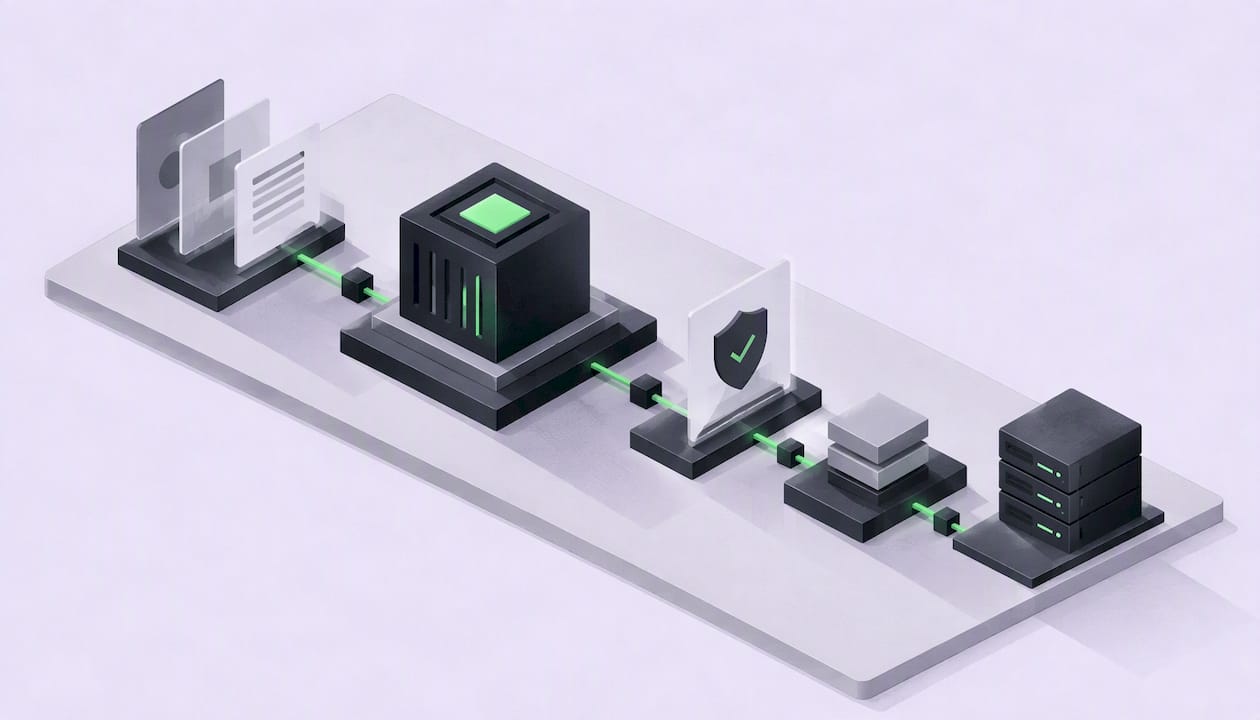
An enterprise-grade AI agent is an LLM-driven system that plans and completes multi-step work inside your real systems, under identity, permissions, monitoring and governance that your security and operations teams can verify. A demo that answers questions well is not that. The gap between the two is where most agent projects stall, and it is the gap this guide helps you close.
We build agents that run inbound sales end to end, so we look at the topic from the production side: what has to be true before an agent is allowed to talk to thousands of your prospects a month and write to your CRM.
TL;DR
- Enterprise-grade means safe under uncertainty, reliable at scale, secure by design and governable over time. Model intelligence is only one input.
- Treat every agent as a non-human principal: an owner, scoped permissions, action-level audit trails and runtime guardrails.
- Evaluate the whole trajectory (every decision and tool call), not just the final answer, and roll out through sandbox, canary and production.
- Design human escalation as a control, with explicit thresholds, not as an admission of failure.
- For high-volume inbound sales, the strongest case is end-to-end execution: response, qualification, eligibility, offer, contract. Redesign the workflow before you add the agent.
Table of Contents
- What “enterprise-grade” actually means
- Why most agents never reach production
- The five requirements that matter in production
- Scalable and production AI agents: the load question
- A rollout process that holds up
- Multilingual sales agents: what to check
- Choosing between platform types
- Our perspective: selective autonomy in inbound sales
- Where VoiceB fits
- How to evaluate a vendor in one meeting
- FAQ
- Sources
What “enterprise-grade” actually means
The phrase gets used loosely, so define it by behavior. An agent is enterprise-grade when you can answer yes to four questions:
- Is it safe under uncertainty? When input is ambiguous, the agent retries within bounds, stops on explicit conditions and hands off instead of improvising.
- Is it reliable at scale? It performs the same at 50 concurrent conversations as at 5,000, and your downstream systems survive the load.
- Is it secure by design? It authenticates to tools with least-privilege credentials and resists prompt injection.
- Is it governable over time? Someone owns it, changes are versioned, and every action can be reconstructed afterward.
OpenAI’s practical guide to building agents describes an agent as a system that uses an LLM to manage workflow execution and make decisions, and that recognizes when a workflow is complete. That is the core difference from a chatbot-style assistant that only produces text. Once a system takes actions, the enterprise requirements follow: identity, permissions, observability, evaluation and auditing.
Why most agents never reach production
Building an agent is now easy. Operating one is not. Deloitte’s coverage of agentic AI in the enterprise reports that around 11% of organizations were actively using agentic systems in production and 14% had deployable solutions, based on 2025 survey data. Treat those as directional figures, since they come from one survey and one period.
Three causes show up repeatedly:
- Capability is mistaken for reliability. A model that handles the happy path in a demo can still fail on the tenth tool call of a long task, and errors compound across steps.
- The agent is layered onto a broken process. If the underlying workflow has five manual handoffs, an agent in front of it preserves the bottleneck.
- Governance arrives last. Security and compliance reviews start after the pilot, and the project waits months for answers that should have shaped the design.
The last two are organizational, not technical. Address ownership, workflow redesign and rollout accountability before expanding from pilot to production.
The five requirements that matter in production
1. Identity and least-privilege access
An agent that can read a customer record and generate a contract is a principal in your environment. The Cloud Security Alliance’s research note on NIST agent standards work says agent identity, authentication, delegated authorization and audit obligations are becoming central. In practice:
- Give each agent its own credential, never a shared admin login.
- Scope permissions to the tasks in the workflow: read eligibility data, write a lead status, create a draft contract, nothing else.
- Assign a named human owner and a credential rotation schedule.
2. Observability and audit trails
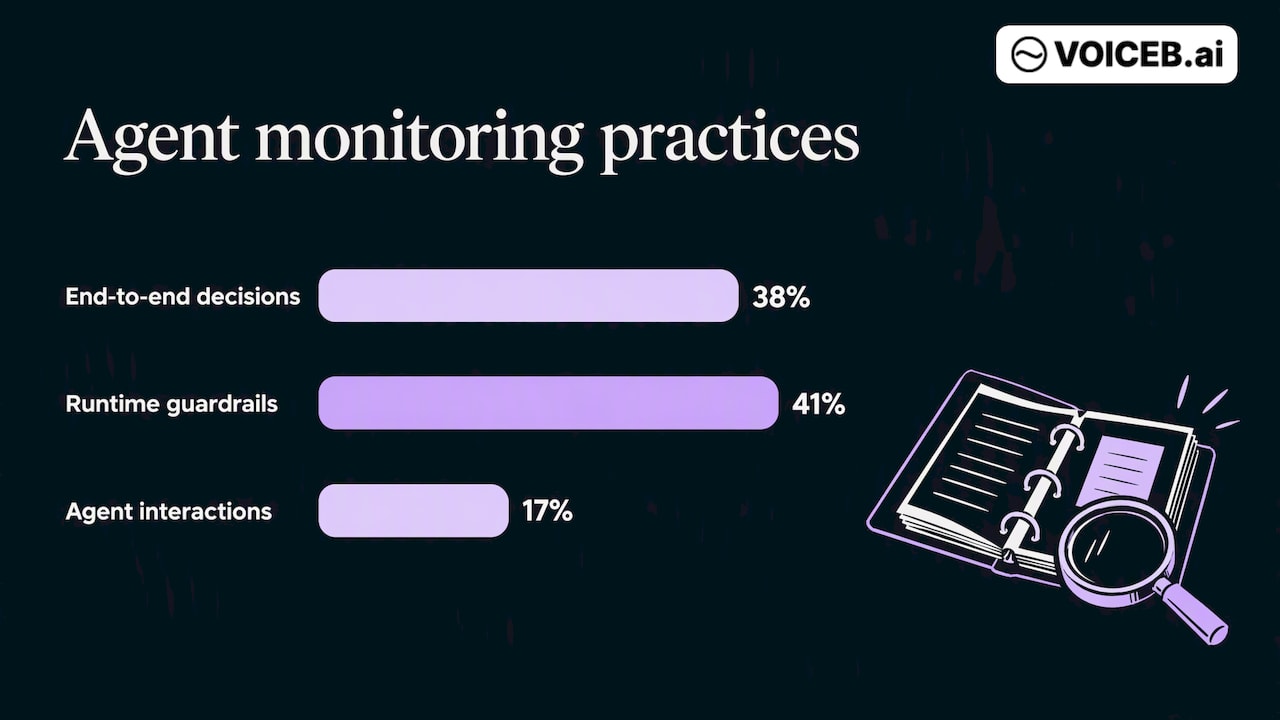
The same CSA research reports that only 38% of organizations monitor agent decisions end to end, 41% have runtime guardrails and 17% continuously monitor agent-to-agent interactions. That means most teams cannot fully explain what their agents did last Tuesday.
An enterprise-grade setup logs the conversation, each tool call, each decision point and the result, in a form a compliance reviewer can read. If the log stops at the model’s text output, you are blind to the actions that carry the risk.
3. Evaluation of the full trajectory
Google Cloud’s guide to production-ready agents makes the point plainly: when an agent makes its own decisions, success depends on sound judgment throughout the process, not only on a correct final output. Build test sets that check intermediate steps: did the agent call the eligibility check before quoting? Did it stop after the retry limit? Did it hand off when the customer asked for a person?
4. Architecture that contains errors
Google Research’s study of scaling agent systems evaluated 180 agent configurations. Multi-agent coordination improved performance on parallelizable tasks but degraded it on sequential ones. Inbound sales is largely sequential: greet, qualify, check eligibility, configure, contract. That favors a tightly controlled single flow with clear state over a swarm of loosely coordinated agents.
Anthropic’s research on building effective agents adds the discipline: find the simplest solution that works and add complexity only when needed, because agents trade latency and cost for task performance.
5. Human escalation as a control
Escalation rules belong in the design from day one. Typical triggers are a retry or failure threshold, a sensitive or irreversible action, a customer request for a person, or a confidence drop on an eligibility decision. When the agent hands off, the human should receive the full context so the customer never repeats themselves.
Scalable and production AI agents: the load question
Teams often test one conversation and assume it scales. It does not automatically. Concurrency stresses the parts around the model: your CRM’s API rate limits, the eligibility service, the contract system, telephony capacity.
Before go-live, test these:
| Check | What you are looking for |
|---|---|
| Peak concurrency | Latency and error rate at your busiest hour plus a margin |
| Downstream limits | API rate limits, connection pools and timeouts in the CRM and back-office systems |
| Failure behavior | What happens when a tool is down: queue, retry within bounds, or hand off |
| Consistency | Two simultaneous conversations with the same lead do not create duplicate records |
| Cost per conversation | Model, telephony and integration cost at volume, not at pilot scale |
Stateless instances with shared state, bounded retries and rate limiting are standard patterns here. They are also unglamorous, which is why they are skipped in pilots.
A rollout process that holds up
This sequence combines the staged approaches cloud providers and agent researchers recommend:
- Define a measurable workflow and risk tier. For example: inbound energy-plan inquiries, from first contact to signed contract, with contract creation as the highest-risk step.
- Map data and tools. List every system the agent reads or writes, and who owns each.
- Create least-privilege identities. One per agent, scoped to the workflow.
- Build and test in a sandbox. Use synthetic and anonymized leads, including hostile and confusing inputs.
- Evaluate complete trajectories. Score decisions and tool calls, not only the final message.
- Load-test. Include the downstream systems.
- Run a canary. Route a small share of live inbound traffic and compare conversion, handoff rate and complaints against your human baseline.
- Expand with monitoring, escalation and rollback. Keep the ability to return traffic to your existing process within minutes.
The canary stage is where leaders learn the most. Decide in advance what result earns more traffic and what result triggers rollback.
Multilingual sales agents: what to check
Many enterprises serve customers in more than one language, and readers searching for multilingual sales agents usually ask the same thing: does quality hold outside English? Do not accept a language list as proof. Ask for evaluation results per language on your own scripts, including accents, code-switching, product terms and number formats. Check that escalation works in each language, that human agents are available to receive the handoff, and that the contract documents are generated in the right language and legal form. Compliance requirements such as call recording consent differ by country, so confirm them for each market you serve.
Choosing between platform types
The market offers several types of option, and the right one depends on the problem:
- General agent-building platforms from large cloud providers. Strong on model choice, tooling and governance primitives. You assemble the sales workflow yourself, which suits teams with engineering capacity and a long horizon.
- Automation suites that combine robots, APIs and people. Good where the work is mostly back-office process automation.
- Data and analytics platforms with agent lifecycle control. Useful where the agent is an extension of existing data science work.
- Purpose-built agents for a specific revenue workflow. The workflow logic, integrations and guardrails are already designed for the job, so time to a live canary is shorter.
Compare any of them on integration with your systems of record, runtime isolation, identity, human escalation, evaluation, auditability and lifecycle governance. Model intelligence alone is a poor tiebreaker, since the best choice depends on the use case rather than a universal ranking.
Our perspective: selective autonomy in inbound sales
We see enterprise-grade as a property of the workflow, not of the model. Inbound sales at volume is a good test case. A telecom or energy company receives thousands of leads a month, each needing a quick response, an eligibility check, an offer configured to the customer’s situation and, if the customer agrees, a contract. Most conventional AI stops after qualification and passes the lead along. The revenue leaks in the steps that follow.
Our agents execute the whole sequence: the first conversation, eligibility checks, offer configuration and contract generation, working across the systems you already run. Primagas (SHV Energy) saw a 150% increase in sales volume, 250% more lead-handling capacity and a 37% reduction in cost per acquisition, with a 67.8% autonomous close rate over 12 months. Holaluz closes 30.4% of valid inbound calls autonomously and auto-filters 78% of traffic. Those are outcomes for those customers’ workflows, not a promise for every deployment.
What we believe about autonomy:
- Autonomy should be graduated. Start where risk is low and expand as the evidence arrives. Our platform overview describes autonomy levels L1 to L4 for this reason.
- Governance is a product feature. Agents need to be built, tested and controlled in one place, which is why we offer Agent Studio for building and governing sales agents.
- Autonomous agents own inbound sales end to end. Humans handle genuine exceptions outside approved rules, sensitive decisions or explicit customer requests for a person.
- Fix the process first. An agent on top of five manual handoffs still has five handoffs.
— Alex Bisbe, Co-founder & CEO, VoiceB.ai
Where VoiceB fits
Every VoiceB deployment runs on Autonomous Sales Voice Agents (ASVA), and every conversation is classified by the Outcome Engine: a deterministic, auditable classification that assigns one of four outcomes, Invalid, Qualified Transfer, Sold or Closed. See how this works in production in our case studies for Primagas (SHV Energy) and Holaluz.
Autonomous agents own the routine inbound sale end to end, from first response through eligibility, offer configuration and contract generation; humans handle genuine exceptions outside approved rules.
If you handle high inbound volume and want an agent that carries a lead through to a closed contract, start with our Autonomous Sales service. If your first need is faster, more consistent qualification, see AI lead qualification. For sector detail, we publish pages for energy, utilities, insurance and automotive.
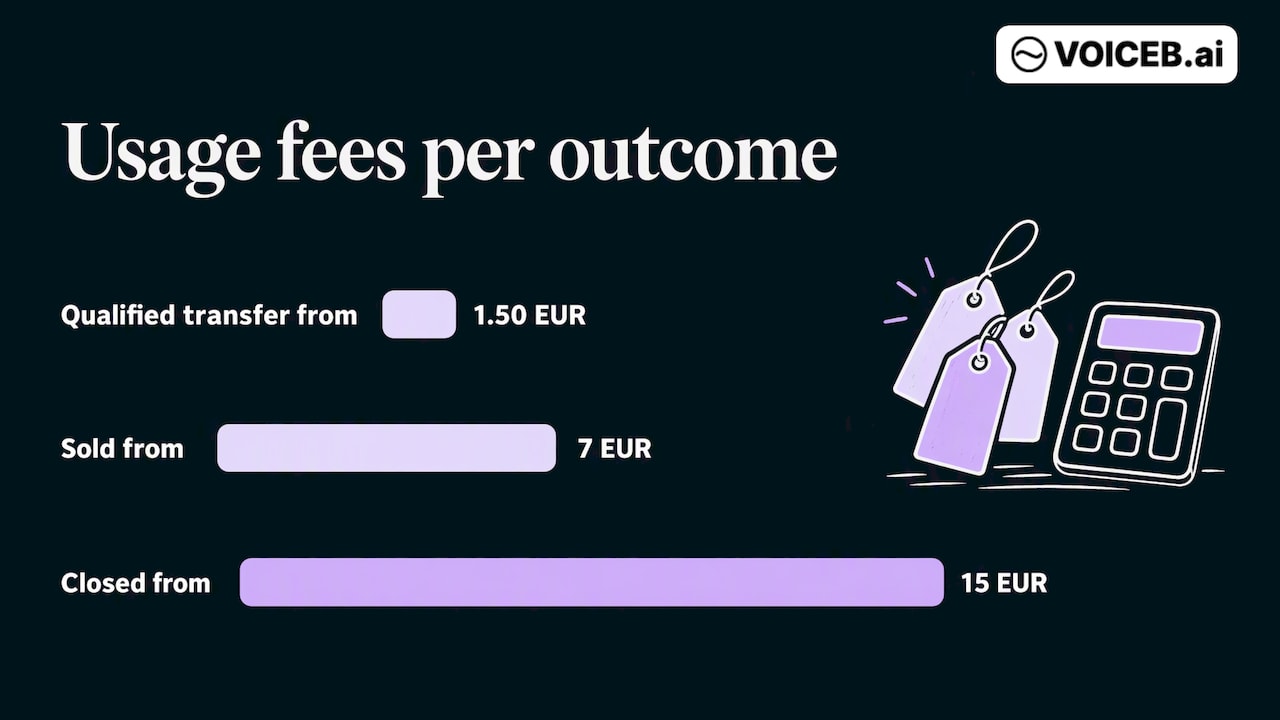
Pricing is published at our pricing page across Starter, Enterprise and Corporate Custom plans, without a listed plan price. The published usage fees are: Qualified Transfer from 1.50 EUR one-off, Sold from 7 EUR one-off and Closed from 15 EUR one-off. Custom integrations are 900 EUR per day per DevDay. You can also read how outcome-based pricing works, where you pay for results rather than seats.
How to evaluate a vendor in one meeting
Bring this list to the first technical session:
- Show me the audit trail for one completed conversation, including every tool call.
- What identity does the agent use in our CRM, and what can it write?
- Which steps trigger human escalation, and what context does the person receive?
- How do you test trajectories, not only final answers?
- What happens when our contract system is slow or down?
- What did concurrency testing show, and at what volume?
- How do we roll back to our current process?
- Which languages are evaluated, and how?
A vendor that answers these with screens and numbers is ready for production. One that answers with a model name is not. For a broader view of agent types and ROI, see our guide to AI sales agents, and for the cost and speed trade-off against staffed teams, our comparison of AI voice agents and human sales teams.
FAQ
What is an enterprise AI agent?
It is an LLM-powered system that combines a model, tools and explicit instructions to plan and carry out multi-step work across enterprise data and applications. The enterprise part adds identity, permissions, observability, evaluation and governance. Without those, it is a prototype.
What makes an AI agent enterprise-grade?
Four properties: it behaves safely under uncertainty, stays reliable at scale, is secure by design and can be governed over time. You verify them with trajectory evaluation, load tests, audit logs and a staged rollout, not with a vendor’s description.
Which AI agent is best for enterprise applications?
There is no universal best. When the path is predictable, a simpler workflow often beats an autonomous agent, as Anthropic’s research notes. Use an autonomous agent when the task is open-ended and needs decisions and recovery across variable steps. For high-volume inbound sales, a purpose-built agent that owns the full workflow is usually the fastest route to a measurable result.
Do enterprise agents replace human sales teams?
Autonomous agents own the routine inbound sale end to end: response, qualification, eligibility, offer configuration and contract generation. Humans handle genuine exceptions, sensitive decisions outside approved rules or explicit requests for a person.
Sources
- A Practical Guide to Building AI Agents
- Agentic reality check, Deloitte
- CSA research note on NIST AI agent standards
- A dev’s guide to production-ready AI agents
- Towards a science of scaling agent systems
- Building effective AI agents, Anthropic